The real test of an operating model is not how responsibilities are drawn, but how work moves when the strategy demands coordinated action.
A leadership team announces a strategic shift. The company will move from selling individual products to delivering integrated solutions. Customers will receive a more coherent experience, the business will capture more value from existing relationships, and investment will move toward the opportunities with the greatest long-term potential.
The strategy is clear. The organization chart has been updated. New roles have been appointed. A transformation program is in place.
Then a major customer asks for a solution that spans three business units. The commercial team needs a single price and commitment. Operations must reconcile different delivery capacities. Technology needs agreement on which systems will support the offer. Finance wants to know which unit owns the margin and who funds the investment.
The customer experiences one company. Internally, the work still travels through several.
The question is no longer whether executives understand the strategy. It is whether the organization has a way to act on it.
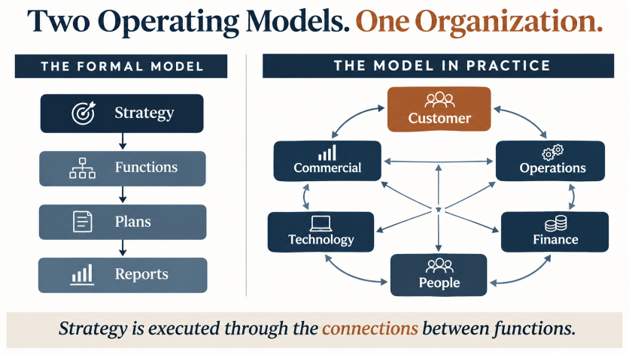
That is the operating model in practice. Not the diagram describing who reports to whom, but the pattern of decisions, resources, interfaces and commitments through which the enterprise creates value.
The organization chart is not the operating model
An organization chart answers a necessary question: where does formal authority sit? It does not fully explain how a customer promise is delivered, how scarce expertise is allocated, or how two functions resolve a trade-off when both have legitimate priorities.
An operating model is broader. It encompasses the way work is organized, decisions are made, capabilities are deployed, information moves, performance is measured and people are held accountable. Some of those mechanisms are formal. Others are embedded in routines and habits that no one has written down.
The distinction matters because a company can change its structure without changing its operating behavior. A new business-unit leader may inherit the same budget boundaries. A newly formed customer team may still need approvals from five functions. A transformation office may track milestones without having the means to resolve the dependencies between them.
McKinsey’s June 2025 research on operating-model redesign surveyed 2,000 executives across 16 sectors. Its findings emphasize not just structure but leadership alignment, rewiring core processes, investing in people and sustaining a high-performing culture. The survey identifies associations with redesign success, not a universal recipe or proof of causation.
The implication is practical: changing the boxes can make accountability more visible, but the connections between the boxes determine whether the change works.
Where strategy meets the work
A strategy usually changes what an organization must be good at. A move toward integrated solutions requires coordination across product lines. An acquisition thesis requires the acquired businesses to share selected capabilities. A shift toward recurring revenue requires commercial, service, data and finance teams to work against a common customer lifecycle.
Yet many companies implement strategy by assigning initiatives to existing functions. Each function develops a plan, secures resources and reports progress through its own management chain. That approach is sensible for work contained within a function. It is much less reliable when the value depends on several functions changing together.
The friction often appears at interfaces: the handoff between selling and delivery; the point where product priorities compete for technology capacity; the boundary between local customer needs and enterprise standards; or the moment a business unit needs a shared resource that another unit controls.
These interfaces are not peripheral administrative details. They are where the strategy becomes either executable or aspirational.
Consider the integrated customer offer in the opening example. Success requires more than naming an account owner. The company must establish who can commit delivery capacity, who owns the economics of a bundled offer, which customer data is shared, and how exceptions are resolved without sending every disagreement to the executive committee.
The operating model is the answer to those questions, whether leaders designed it intentionally or allowed it to emerge by default.
The hidden operating model
Every organization has two operating models. One is the formal model described in presentations, policies and role definitions. The other is the model people experience when they try to get something important done.
The second can be observed. Follow a consequential customer request, product launch or investment decision from beginning to end. Notice where the work waits, which people are repeatedly consulted, where information must be reconstructed and who can actually release resources.
You may discover that the formal owner does not control the capacity needed to deliver. A committee described as advisory may function as a veto point. A shared service may be measured on utilization rather than the speed or value of the outcomes it enables. Local managers may be rewarded for protecting budgets even when enterprise strategy requires moving resources elsewhere.
None of these behaviors is necessarily irrational. Each can be a reasonable response to the incentives and authorities the organization has established. Together, however, they can produce an operating model fundamentally at odds with the strategy.
This is why asking people to collaborate more is rarely sufficient. Collaboration cannot reliably compensate for incompatible measures, inaccessible resources or unresolved authority. Those conditions must be designed, not merely encouraged.
A documented example: changing the work, not just the labels
ING’s transformation in the Netherlands offers a useful historical illustration. In a 2017 interview, senior executives described moving commercial and IT colleagues into multidisciplinary squads focused on customer needs, supported by revised roles, governance, technology delivery practices and people systems. The company also distinguished functions that needed independence, such as risk and legal, rather than forcing every activity into the same team design.
The example is older than the contemporary research used elsewhere in this article, and it should not be read as evidence that every company ought to adopt squads. Its relevance is the breadth of the change. ING’s leaders described not simply a new chart, but a different arrangement of decision-making, work, technical delivery and performance management.
That is the more general lesson. An operating model cannot be copied as a fashionable structure. It must reflect how the particular enterprise creates value, where coordination is essential and where independence is non-negotiable.
Five mechanisms that make a strategy executable
An effective operating model makes five questions answerable in daily work.
First, where does value actually flow? The organization must understand its critical end-to-end activities, from customer demand to fulfilled promise, rather than optimizing only the steps inside each function.
Second, who can make which decisions? Authority should sit where the relevant information and consequences can be considered, with explicit escalation for trade-offs that genuinely require enterprise judgment. Clarity matters, but so does the ability to involve the people whose commitments make the choice real.
Third, how do resources move? Strategy changes priorities, but budgets, specialist capacity and leadership attention often remain anchored to the previous year’s structure. A functioning model creates a way to reallocate scarce resources when enterprise value requires it.
Fourth, what does performance reward? If business units are measured only on local margins while being asked to share talent or serve common customers, the measures may work against the strategy. Shared outcomes need compatible incentives without eliminating necessary local accountability.
Fifth, what is the operating cadence? An annual plan and monthly status review are not enough for work that changes weekly. Leaders need recurring forums in which dependencies are exposed, decisions are resolved, commitments are updated and results change the next set of priorities.
These mechanisms reinforce one another. A clear decision right is of limited use without resource access. Shared metrics are weak if teams cannot act on what they reveal. A cadence becomes bureaucracy if it reports activity but cannot resolve constraints.
The argument against redesigning everything
There is a reasonable objection to all this: operating-model redesign can become an expensive distraction. New structures interrupt relationships, create uncertainty and consume leadership capacity. A stable business may perform better by improving a few handoffs than by launching another enterprise transformation.
That objection deserves to be taken seriously. Not every strategic change requires a new organization chart, a matrix or a cross-functional team for every activity. Some work benefits from specialization, standardized processes and clear hierarchical accountability. Regulated functions may need deliberate separation. Local autonomy may be essential when markets differ.
The test is not whether the model looks modern. It is whether the mechanisms match the work the strategy requires.
A targeted intervention may be enough: redesign the interface between sales and operations, create a shared investment decision, alter the allocation of technology capacity, or establish a forum with real authority over an end-to-end customer journey.
Conversely, when the strategy fundamentally changes how value is created, local fixes may be insufficient. The operating model itself must change. The scale of redesign should follow the scale of the mismatch, not the enthusiasm for reorganization.
How to see the gap before it becomes a transformation program
The most useful diagnostic is often not a survey asking whether the operating model is clear. It is an examination of recent work.
Choose a strategic outcome that requires several functions. Trace one real instance of that work from initiation to delivery. Identify every decision, handoff, resource request, exception and performance measure that influenced its progress. Ask where time was spent and why.
Then compare the observed path with the path leaders believe the work should follow.
Did the accountable leader have authority but not resources? Were teams optimizing different definitions of success? Did information arrive too late? Did an exception have to travel three management layers? Was the customer outcome visible to everyone involved, or only to the final team in the chain?
The answers reveal the actual operating model. They also identify which changes are worth making first.
McKinsey’s August 2025 analysis of end-to-end processes argues that structural redesign alone can leave underlying work and behaviors untouched. That is a useful caution. The most productive changes often remove unnecessary steps, synchronize dependent activities and simplify the movement of information and decisions, rather than adding another layer of coordination.
A practical distinction: coordination versus integration
Not every dependency needs a permanent cross-functional team. Some activities need only a reliable handoff: a standard, a service-level commitment and a clear exception path. Others demand genuine integration because the functions must make simultaneous trade-offs about customers, cost, capacity and risk. Confusing these two situations can make the organization either too fragmented or unnecessarily complicated.
The distinction can be tested by asking whether one function can complete its work successfully once it receives a defined input, or whether the outcome depends on several functions adapting their choices together. The first calls for a better interface. The second may require shared priorities, joint decision-making and an operating cadence that keeps commitments synchronized.
The design challenge is therefore selective: integrate where value depends on joint action, preserve functional depth where specialization matters, and avoid turning every interaction into another committee.
The executive test
For CEOs, COOs, CSOs and operating partners, I would start with five questions.
- Which strategic outcomes require multiple functions to act as one system?
- Where do those outcomes encounter recurring handoffs, competing priorities or resource bottlenecks?
- Who has the authority and capacity to resolve those issues at the level where they occur?
- Do incentives and performance measures reinforce the enterprise outcome or reward local optimization?
- What recurring mechanism turns new information into decisions, commitments and adjustments?
If the answers depend on a handful of executives personally connecting the organization, the operating model may be relying on leadership heroics rather than institutional capability.
The strategy is not truly embedded when people can repeat its priorities. It is embedded when those priorities shape the ordinary movement of work, resources and decisions without requiring constant exceptional intervention.
That is why the operating model is not an implementation detail that follows strategy. It is the means through which strategy becomes real.
The organization’s operating model is revealed not by what its leaders have drawn, but by what its people are able to do together.
References
- McKinsey (June 25, 2025). The new rules for getting your operating model redesign right.
- McKinsey (August 27, 2025). Want to break the productivity ceiling? Rethink the way work gets done.
- McKinsey (June 18, 2025). A new operating model for a new world.
- McKinsey (January 10, 2017). ING’s agile transformation. Historical case interview. https://www.mckinsey.com/industries/financial-services/our-insights/ings-agile-transformation