Steven Saunders · Surge POV Series · Part IV
Continuation funds became an important pressure valve when exit markets tightened, valuations diverged and timelines stretched.
They offered sponsors a way to extend ownership, provide liquidity and preserve optionality without forcing an immediate sale.
But changing the ownership structure does not automatically change how the organization executes.
Why continuation funds surged
Sponsors faced a difficult combination:
- Assets they still believed could create more value
- Limited IPO opportunities
- Cautious strategic buyers
- Volatile financing conditions
- LP expectations for liquidity
Continuation vehicles offered a way to reconcile those tensions. They could provide liquidity, reset ownership and give the company more time.
In many cases, that flexibility was valuable.
What the forecast actually says
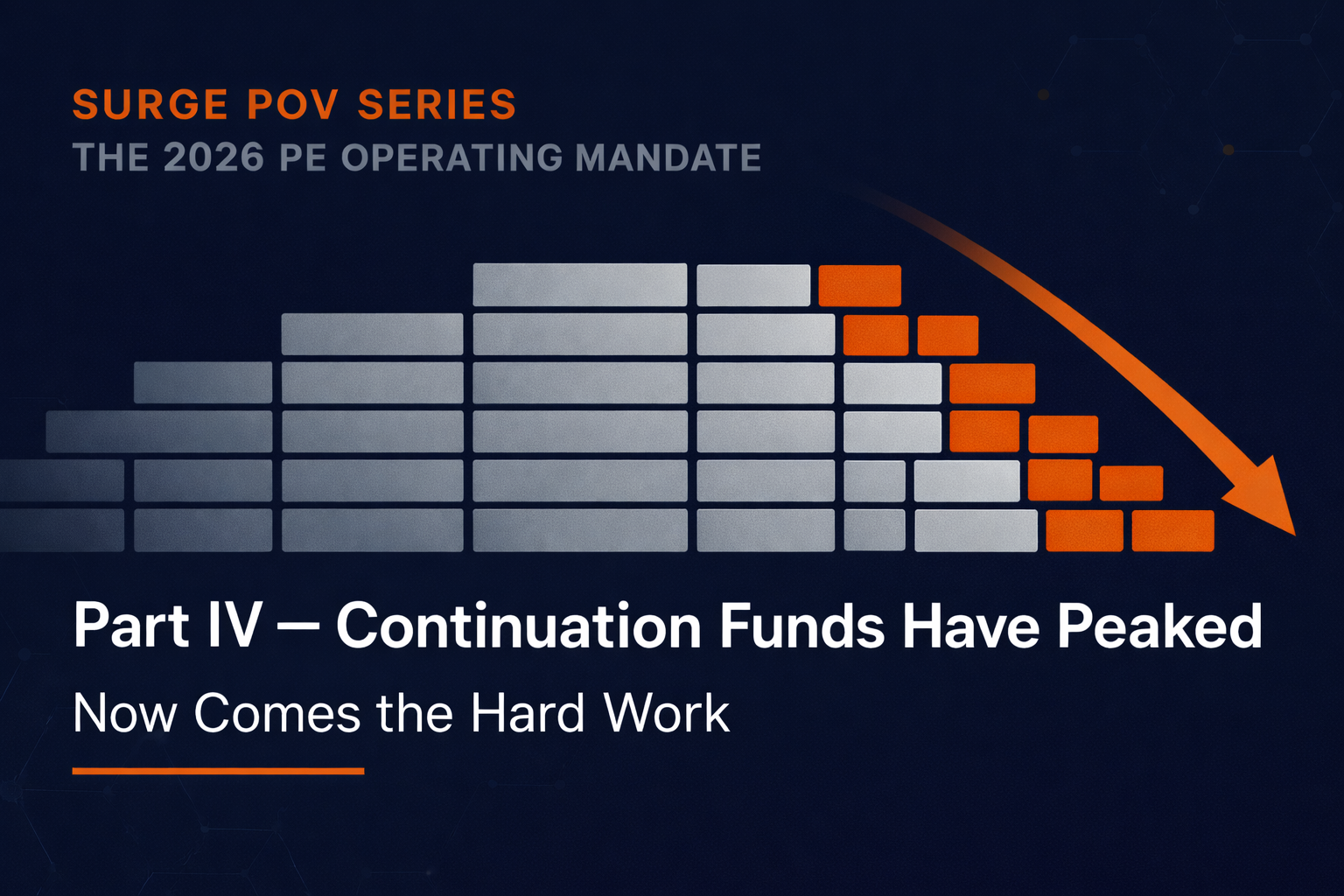
PitchBook’s December 2025 outlook forecast that continuation fund-related exits would fall below their 2025 peak in 2026.
That is a forecast about exit activity, not proof that continuation funds have permanently peaked or lost their usefulness.
The operating implication is more durable: an extended hold still needs a credible plan for what the organization will do with the additional time.
A continuation structure can buy time. It does not automatically buy momentum.
The execution gap inside long-hold assets
Long-held companies can accumulate:
- Multiple leadership transitions
- Layered value-creation plans
- Operational and organizational debt
- Legacy priorities alongside new expectations
- Assumptions that no longer fit the market
Everyone may be busy. The strategy deck may look current. Initiatives may be underway. Yet progress can feel slower than it should.
The challenge is often coherence.
Teams execute against different versions of the plan. Decision rights blur. Priorities compete. What was once a clear value-creation story becomes a collection of activities.
Extended ownership can preserve that drift unless the operating agenda is deliberately reset.
The false comfort of more time
Time creates the opportunity for value. It does not create value on its own.
The organization still needs:
- Clear priorities
- Explicit trade-offs
- Decisions at the right level
- Coordinated execution
- An operating rhythm that sustains momentum
Without those capabilities, an extension can give unresolved issues more room to compound.
Treat the vehicle as an execution reset
The practical question is not only whether the asset deserves more time. It is what must change inside the organization during that time.
A reset should:
- Reestablish a small number of enterprise priorities
- Align leaders and teams around sequencing
- Clarify decision rights that have eroded
- Resolve dependencies across functions
- Rebuild a cadence that connects board intent to frontline execution
Some of the most valuable work is subtractive: stop initiatives that no longer support the value-creation plan, retire outdated assumptions and make the next set of commitments clear.
Turning extension into acceleration
The operating story should be visible in decisions, ownership and progress – not just a revised timeline.
Has leadership regained momentum? Has the organization reduced complexity? Are the next priorities clear enough for teams to act on? Is the additional time being used deliberately?
Those questions help distinguish an extension in ownership from a renewal of execution.
The takeaway
Continuation funds can be a useful financial structure. The next phase of value creation still depends on what happens inside the asset.
A deliberate execution reset turns more time into a better chance of operating improvement and exit readiness.
Source: PitchBook, 2026 US Private Equity Outlook, published December 3, 2025, pages 9-10. The anticipated decline is a forecast; the operating implications are my interpretation.
Related thinking
The Exit Backlog That Won’t Clear Itself: Why PE’s Biggest Challenge in 2026 Is Now Structural