A company is preparing to launch a major new product.
Commercial leadership wants to move quickly to capture a market opportunity. Operations questions whether production capacity can support the proposed launch. Finance wants greater certainty before releasing investment. Technology has dependencies that must be resolved before the new model can operate at scale.
Each function has a legitimate position. Each is protecting something important to the business.
The leadership team discusses the issue. More analysis is requested. A follow-up meeting is scheduled. The decision remains open.
But the organization does not stop working.
Commercial continues preparing for the original date. Operations develops alternative capacity plans. Finance holds back funding. Technology proceeds with work that may need to change once the direction is settled.
Weeks later, the issue returns to the executive agenda.
By then, people have worked against different assumptions, resources have been committed to competing scenarios, and dependencies have grown more complicated. Some work must be repeated. Other work has not begun. The market opportunity has continued to move.
Nothing in this illustrative situation necessarily reflects weak leadership or poor judgment. The problem is that the organization has not resolved a decision on which collective progress depends.
An unmade decision is rarely an isolated event. Its consequences spread through the organization long before anyone calculates what the delay has cost.
The cost that financial reports struggle to show
Organizations scrutinize the decisions they make. Investment committees evaluate returns. Boards review strategic choices. Executives assess whether initiatives delivered their promised benefits.
Decisions that remain unresolved receive far less economic scrutiny.
A January 2026 West Monroe survey of more than 1,200 US executives and managers found that 73% of respondents estimated their organizations lose up to 5% of annual revenue because of slow decision-making and delayed execution.
These were respondents’ estimates, not audited financial losses. The research also examined delayed execution broadly, rather than isolating decisions that were never made.
Nevertheless, the findings highlight an important issue: decision delays are not simply administrative inefficiencies. They can carry significant commercial consequences.
The cost has several components.
Delay. A launch, investment, integration milestone or customer commitment cannot advance as planned.
Duplicated effort. Teams maintain alternatives, commission additional analyses or prepare for competing outcomes.
Rework. When the decision is finally made, assumptions change and completed work must be revisited.
Leadership attention. Issues that should be resolved within the operating organization repeatedly consume executive time.
Foregone value. Benefits arrive later, competitors move first or opportunities disappear entirely.
These consequences rarely appear together in financial reporting.
Commercial records a missed date. Operations absorbs additional planning work. Technology writes off effort. Finance sees expected benefits move into the next quarter.
Each report may be accurate. None necessarily identifies the common cause.
The cost of indecision is difficult to see precisely because the organization experiences it in pieces.
What does one unresolved decision actually cost?
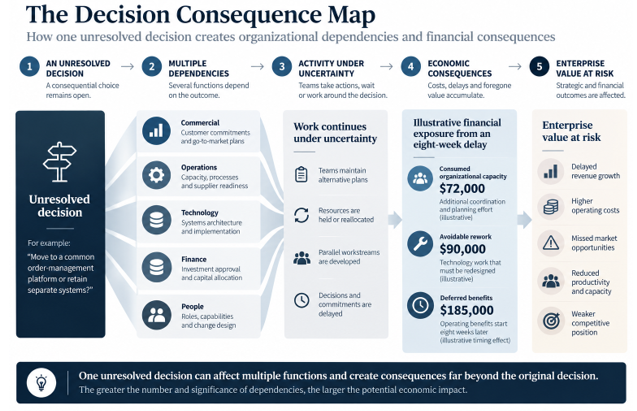
Consider a hypothetical integration decision: whether two acquired businesses should move to a common order-management platform or retain separate systems.
The decision remains unresolved for eight weeks. During that period, both organizations continue preparing for different possible outcomes.
A 12-person cross-functional team spends an additional six hours per person each week maintaining parallel plans. At an illustrative fully loaded rate of $125 per hour, that represents $72,000 of organizational capacity consumed.
Technology teams also undertake work that must subsequently be redesigned. Assume $90,000 of that effort could have been avoided had the decision been resolved earlier.
Meanwhile, an operating improvement expected to deliver $1.2 million annually begins eight weeks later than planned. At a straight-line run rate, approximately $185,000 of expected benefits shifts into a later period.
These figures are hypothetical, not typical costs or research findings. The illustration assumes the decision could have been made earlier without compromising its quality, and that the cost categories do not overlap.
The economic distinction matters.
Staff time represents capacity consumed, not necessarily additional cash spending. Rework may create avoidable costs. Delayed benefits affect timing and may or may not become permanently lost value.
Yet all three consequences arise from the same unresolved decision.
And they are likely to appear in different places: staffing reports, technology budgets and financial forecasts.
The largest consequence may not be the time executives spent discussing the issue. It may be the work the rest of the organization performed around it.
Why indecision can look like progress
A company waiting for a decision can appear remarkably busy.
Meetings continue. Project dashboards show completed activities. Functions pursue their own objectives. Teams prepare contingency plans and report milestones.
From inside each function, the activity can be entirely rational.
Commercial is protecting growth. Operations is protecting reliability. Finance is exercising discipline. Technology is managing delivery risk.
Yet local progress does not necessarily add up to enterprise progress.
Gartner’s 2024 research found that 84% of surveyed marketing leaders and employees experienced high collaboration drag, involving excessive meetings, feedback loops and unclear decision authority when working across functions.
The research also found that organizations experiencing high collaboration drag were 37% less likely to achieve their revenue goals.
The study examined marketing-related cross-functional work rather than enterprise decision-making as a whole. Nevertheless, it illustrates how organizational friction can consume effort without resolving underlying issues.
More meetings do not necessarily produce alignment. More information does not automatically produce a decision. And more activity does not guarantee forward movement.
When a consequential choice remains open, teams may optimize against different assumptions. Their individual scorecards can look healthy while the enterprise pays for the inconsistency.
Why capable leaders cannot always resolve the choice
It is easy to blame indecision on cautious executives or slow committees. Sometimes that criticism is justified.
But consequential decisions frequently stall because of conditions built into the organization.
Competing objectives. A commercial leader is measured on growth, an operations leader on reliability, and a CFO on capital discipline. Each can defend a sensible position. The unresolved question is which trade-off best serves the enterprise.
Dependencies discovered too late. A decision that appears to belong to one function depends on capacity, systems, people or funding controlled elsewhere. Those dependencies emerge as objections late in the process rather than being resolved while options are developed.
Authority without readiness. A decision-maker may have formal approval rights but lack the shared information, implementation commitments or organizational support needed to make the choice executable.
Different interpretations of the objective. Leaders can agree on a strategic ambition while disagreeing about what must change, which risks matter most and what should take priority when resources are constrained.
The issue moves upward. Additional analysis is requested. Functions defend their positions. The meeting ends without resolving the underlying trade-off.
The organization is not necessarily short of intelligent people. It may be short of the connections and decision mechanisms that allow those people to act coherently.
When a systems decision becomes an integration problem
In an August 2026 article, M&A Integration Discipline Is an Operating System, DLA Piper’s Guy Fisher describes a bolt-on acquisition in which a decision about which technology systems to retain remained unresolved for months.
An integration owner had been appointed, but cross-functional decision forums and agreed authority levels had not been established.
The systems decision involved technology, finance, HR and other functions. Without an effective mechanism for resolving their competing requirements, the issue moved sideways and delayed integration.
The company is unnamed, and the practitioner account does not quantify the financial consequences.
Appointing an owner did not establish the conditions required for the organization to make and execute the decision.
The multiplier is dependency, not just time
A decision’s cost depends on more than the number of days it remains open.
A minor choice affecting one team may wait for weeks with limited consequences. A decision affecting customer commitments, capital investment, operating capacity and technology priorities can create substantial disruption in a much shorter period.
I think of this through three lenses:
Decision delay: How long has the choice remained unresolved, and why?
Dependency exposure: Which functions, investments, commitments and activities depend on its outcome?
Execution consequences: What work is delayed, duplicated, misdirected or at risk of losing value?
Together, these form a practical way to examine the organizational consequences of an unmade decision.
They are not a validated financial formula. Their purpose is to make dependencies and economic exposure visible before the costs become buried in separate operating reports.
The more interconnected the decision, the wider its consequences can spread.
And making the decision does not necessarily erase the costs already incurred through workarounds, incompatible assumptions and delayed commitments.
The executive question is therefore not simply, How long has this decision been open?
It is:
How much of the organization is working around the fact that it remains unresolved?
Waiting can be the right decision
Speed is not an end in itself.
A safety-critical change may require further testing. An acquisition may warrant additional diligence. A major investment may benefit from waiting for information that could materially alter the choice.
A meta-analysis by Kolev and colleagues, published in the February 2025 issue of Journal of Management Scientific Reports, synthesized 127 empirical studies and found positive overall associations between firm performance and decision speed, implementation speed and competitive response speed.
The researchers also identified contextual factors affecting those relationships.
The evidence supports the value of effective speed. It does not establish that faster decisions always produce better outcomes.
The distinction is between deliberate deferral and organizational indecision.
Deliberate deferral has a named owner, a specific reason for waiting, clear evidence requirements, a decision date or trigger, and an understanding of what the delay costs.
Indecision looks different.
The same issue returns repeatedly. More analysis is commissioned without agreement on what would be sufficient. Functional positions remain fixed. No one can explain what must change for a decision to be made.
Time passes without improving the organization’s ability to choose.
Engineered alignment: from authority to execution capacity
The conventional response to decision bottlenecks is to clarify decision rights: define who recommends, who contributes, who approves and who is accountable.
That matters.
But a name in a decision matrix does not automatically resolve competing priorities or make implementation possible.
A leader can approve a direction while the people responsible for carrying it out still hold different assumptions, face unresolved dependencies or lack the capacity to deliver.
Decision authority answers who can choose. Execution capacity determines whether the organization can act on that choice.
Engineered alignment connects the two.
It brings the relevant leaders and functions into a shared understanding of enterprise priorities. It makes dependencies and trade-offs explicit before they surface as implementation failures.
It establishes who must decide, what information and participation are necessary, what the decision commits each function to do, and how unresolved issues will be surfaced and resolved.
The aim is not consensus on everything.
Complex organizations will always contain legitimate differences in perspective. The objective is to make those differences visible, resolve their implications and establish a coherent course of action.
That changes the role of senior leadership.
Executives still make the consequential choices that belong to them. But they need not personally reconcile every cross-functional conflict or repeatedly arbitrate the same issue.
More decisions can be prepared, made and implemented through the organization’s established connections and operating cadence.
Alignment is therefore not a workshop outcome or a statement of shared intent.
It is an ongoing organizational capability: the ability to convert strategic direction into decisions, commitments and coordinated execution as conditions change.
The executive test: what remains undecided?
Start with the three unresolved decisions that most constrain your current strategic priorities.
For each, ask:
- What exactly remains undecided? Can the issue be expressed as a specific choice rather than a broad problem?
- Who and what depends on it? Which teams, investments, customer commitments or initiatives are proceeding under uncertainty?
- What is happening while we wait? Where are we duplicating effort, delaying benefits or committing resources against assumptions that may change?
- What prevents resolution? Are we waiting for evidence that will improve the choice, or have we failed to reconcile priorities, dependencies or authority?
- What makes the decision executable? Who must participate, who has final authority, and what commitments and follow-through are required?
The answers reveal more than overdue decisions.
They show where coordination is failing, where execution capacity is being consumed, and where senior leadership has become the default mechanism for holding the organization together.
A company can have a clear strategy, capable leaders and well-funded initiatives yet still struggle to deliver because the decisions connecting them remain unresolved.
The most expensive decisions may not be the ones that turn out to be wrong. They may be the ones the organization never quite manages to make.
References
- West Monroe (January 27, 2026). Why Speed Matters: The Competitive Advantage of Faster Business Decisions.
- Gartner (May 14, 2024). Gartner Survey Reveals 84% of Marketers Report Experiencing High Collaboration Drag From Cross-Functional Work.
- Fisher, Guy (August 27, 2026). M&A Integration Discipline Is an Operating System. DLA Piper.
- Kolev, K. D., Dykes, B. J., Kang, S., Hughes-Morgan, M., and Ferrier, W. J. (2025). Fast or Slow? A Meta-Analysis on the Performance Implications of Decision, Implementation, and Response Speed. Journal of Management Scientific Reports, 3(1), 40–67.