Steven Saunders · Surge POV Series · Part I
Private equity is entering 2026 with a problem that no rate cut, rebound in IPOs, or sponsor-to-sponsor activity can fully solve: the industry is carrying a large, aging inventory of portfolio companies.
The operating implications extend beyond the exit calendar.
According to PitchBook’s 2026 US Private Equity Outlook, nearly 12,900 U.S. PE-backed companies sat in sponsor portfolios as of Q3 2025. The age profile of that inventory tells the real story:
- 30% are 7+ years old
- 37% are 4-6 years old
- The median age of still-held assets has risen from 3 years (2022) to 3.9 years (2025)
That is not a temporary delay caused by a slow 2023 exit market. It is a structural shift.
Cohorts that should be long gone are still on the books
The 2017 deal cohort – which should be approaching the end of a normal cycle – still has 37.1% of companies un-exited as it enters year nine. In contrast, the comparable 2012 cohort was down to 26.4% at the same point.
But even more striking: the 2021 record-year cohort is exiting half as fast as 2017 did.
At year four:
- 2021 cohort: 16.6% exited
- 2017 cohort: 32.3% exited
If the current pace continues, only half of the 2021 assets will be exited by year ten – a radical departure from historical monetization cycles.
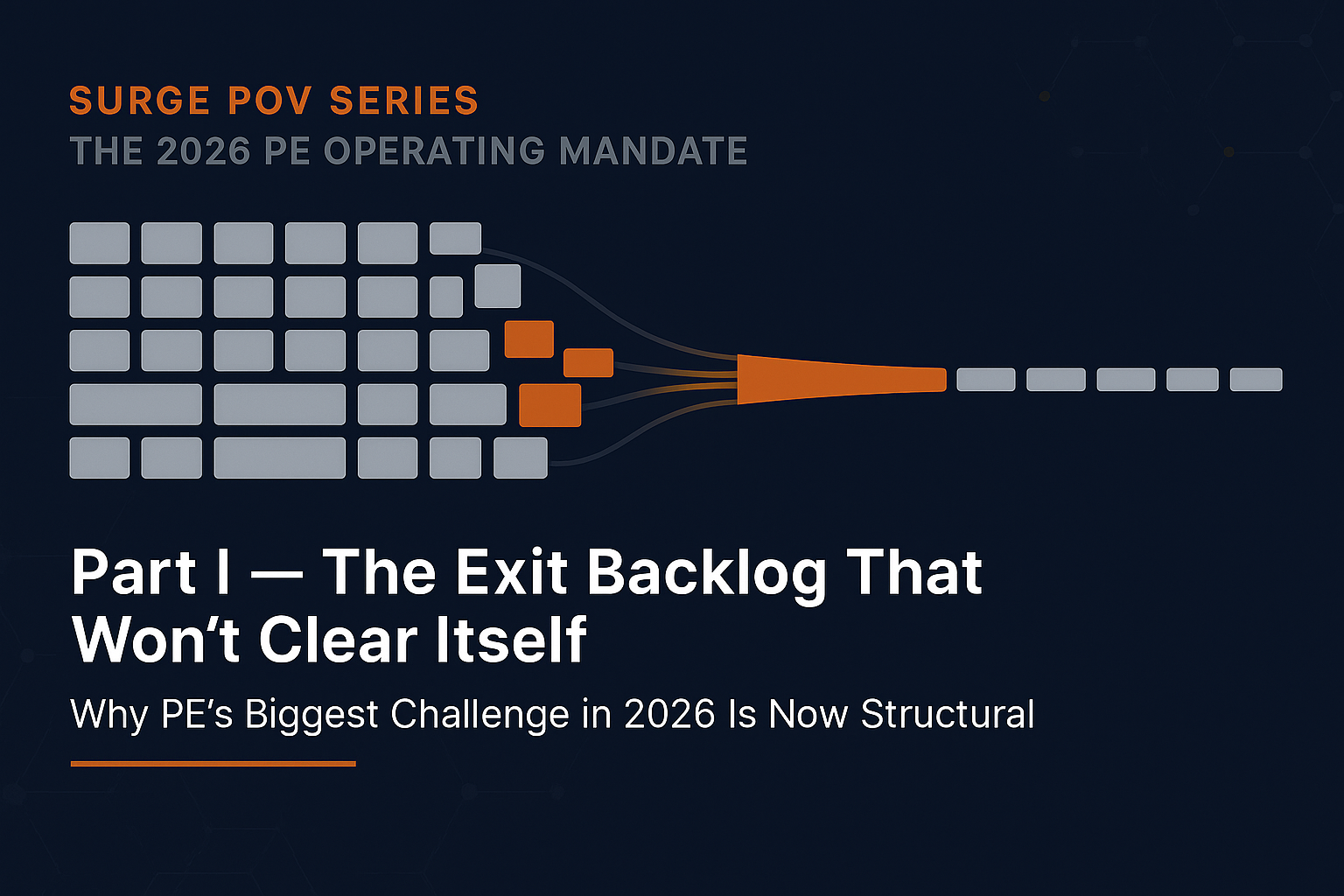
This is no longer a backlog. It’s a bottleneck.
The real issue isn’t just market conditions – it’s organizational drift
Yes, exits slowed because the IPO window froze, debt costs rose, valuation gaps widened, and buyers became selective. But those explanations only describe the environment, not the assets themselves.
The bigger reality is this: the longer an asset sits, the more misalignment can accumulate inside it.
Inside many portcos today, you see patterns that weren’t as present in prior cycles:
- Strategic priorities that shifted three times in five years
- Leadership turnover that hasn’t been fully absorbed
- Commercial, product, and operational teams pulling in different directions
- Value-creation plans that no longer match the current competitive environment
- Critical decisions made slowly or not at all
- Teams still executing on a 2021 or 2022 thesis in a 2026 market
These issues compound. By year six or seven, some companies are no longer simply misaligned – their functions are operating against different versions of the strategy.
That makes them harder to grow. And therefore harder to exit.
Organizational drift can deepen a backlog that market conditions alone will not resolve.
Why this matters: fundraising pressure is rising
PE firms are already navigating a fundraising landscape where capital is concentrating at record levels. PitchBook reports that the top 10 funds captured 45.7% of 2025 capital raised through the report’s November 6 data cutoff.
LPs have become far more selective, backing managers who can:
- Deploy capital with precision
- Exit assets on time
- Demonstrate repeatable operational capability
If exits continue to slip, fundraising becomes even more challenging for mid-market GPs – and the operating burden shifts inward.
Portcos have to perform. Portcos have to show momentum. Portcos have to become exit-ready not in theory, but in calendar time.
The new GP mandate: exit acceleration
Across the industry, sponsors are shifting their operating posture:
- “Asset by asset” value-creation work is being complemented by portfolio-wide operating disciplines.
- CEOs are being pushed to reset priorities rather than add new ones.
- Boards are focusing not just on strategy but on execution rhythm.
- More sponsors are intervening earlier when organizational drift appears.
And internal operating partners are asking a sharper question: “What is preventing this organization from going faster?”
Because in a backlog environment, speed is a differentiator. Speed driven by clarity, alignment, and coordinated execution.
The central insight: you can’t exit what you can’t align
Exit markets may improve without resolving the operating challenges inside aging assets.
GPs cannot rely only on waiting for the market. They need to move their companies.
Exit readiness requires organizations that are:
- Clear on the few priorities that matter
- Aligned across commercial, operational, financial, and product teams
- Coordinated around the value-creation plan
- Operating at a pace that creates momentum and confidence
- Able to deliver consistent signals to buyers
Those capabilities strengthen the operating story, improve readiness and help companies make use of an open exit window.
Source: PitchBook, 2026 US Private Equity Outlook, published December 3, 2025. Figures reflect the report’s 2025 data cutoffs; the ten-year scenario is an extrapolation, not an observed outcome.
Related thinking
Fundraising Is Consolidating – And It’s Raising the Bar on How PE Firms Operate
Platform LBOs Are Back – and Execution Risk Is Higher Than Ever