Category: Strategy Execution

How leaders turn strategic intent into coordinated decisions, clear ownership and accountable action.

  • The Operating Model Is the Strategy in Practice

    The real test of an operating model is not how responsibilities are drawn, but how work moves when the strategy demands coordinated action.

    A leadership team announces a strategic shift. The company will move from selling individual products to delivering integrated solutions. Customers will receive a more coherent experience, the business will capture more value from existing relationships, and investment will move toward the opportunities with the greatest long-term potential.

    The strategy is clear. The organization chart has been updated. New roles have been appointed. A transformation program is in place.

    Then a major customer asks for a solution that spans three business units. The commercial team needs a single price and commitment. Operations must reconcile different delivery capacities. Technology needs agreement on which systems will support the offer. Finance wants to know which unit owns the margin and who funds the investment.

    The customer experiences one company. Internally, the work still travels through several.

    The question is no longer whether executives understand the strategy. It is whether the organization has a way to act on it.

    That is the operating model in practice. Not the diagram describing who reports to whom, but the pattern of decisions, resources, interfaces and commitments through which the enterprise creates value.

    The organization chart is not the operating model

    An organization chart answers a necessary question: where does formal authority sit? It does not fully explain how a customer promise is delivered, how scarce expertise is allocated, or how two functions resolve a trade-off when both have legitimate priorities.

    An operating model is broader. It encompasses the way work is organized, decisions are made, capabilities are deployed, information moves, performance is measured and people are held accountable. Some of those mechanisms are formal. Others are embedded in routines and habits that no one has written down.

    The distinction matters because a company can change its structure without changing its operating behavior. A new business-unit leader may inherit the same budget boundaries. A newly formed customer team may still need approvals from five functions. A transformation office may track milestones without having the means to resolve the dependencies between them.

    McKinsey’s June 2025 research on operating-model redesign surveyed 2,000 executives across 16 sectors. Its findings emphasize not just structure but leadership alignment, rewiring core processes, investing in people and sustaining a high-performing culture. The survey identifies associations with redesign success, not a universal recipe or proof of causation.

    The implication is practical: changing the boxes can make accountability more visible, but the connections between the boxes determine whether the change works.

    Where strategy meets the work

    A strategy usually changes what an organization must be good at. A move toward integrated solutions requires coordination across product lines. An acquisition thesis requires the acquired businesses to share selected capabilities. A shift toward recurring revenue requires commercial, service, data and finance teams to work against a common customer lifecycle.

    Yet many companies implement strategy by assigning initiatives to existing functions. Each function develops a plan, secures resources and reports progress through its own management chain. That approach is sensible for work contained within a function. It is much less reliable when the value depends on several functions changing together.

    The friction often appears at interfaces: the handoff between selling and delivery; the point where product priorities compete for technology capacity; the boundary between local customer needs and enterprise standards; or the moment a business unit needs a shared resource that another unit controls.

    These interfaces are not peripheral administrative details. They are where the strategy becomes either executable or aspirational.

    Consider the integrated customer offer in the opening example. Success requires more than naming an account owner. The company must establish who can commit delivery capacity, who owns the economics of a bundled offer, which customer data is shared, and how exceptions are resolved without sending every disagreement to the executive committee.

    The operating model is the answer to those questions, whether leaders designed it intentionally or allowed it to emerge by default.

    The hidden operating model

    Every organization has two operating models. One is the formal model described in presentations, policies and role definitions. The other is the model people experience when they try to get something important done.

    The second can be observed. Follow a consequential customer request, product launch or investment decision from beginning to end. Notice where the work waits, which people are repeatedly consulted, where information must be reconstructed and who can actually release resources.

    You may discover that the formal owner does not control the capacity needed to deliver. A committee described as advisory may function as a veto point. A shared service may be measured on utilization rather than the speed or value of the outcomes it enables. Local managers may be rewarded for protecting budgets even when enterprise strategy requires moving resources elsewhere.

    None of these behaviors is necessarily irrational. Each can be a reasonable response to the incentives and authorities the organization has established. Together, however, they can produce an operating model fundamentally at odds with the strategy.

    This is why asking people to collaborate more is rarely sufficient. Collaboration cannot reliably compensate for incompatible measures, inaccessible resources or unresolved authority. Those conditions must be designed, not merely encouraged.
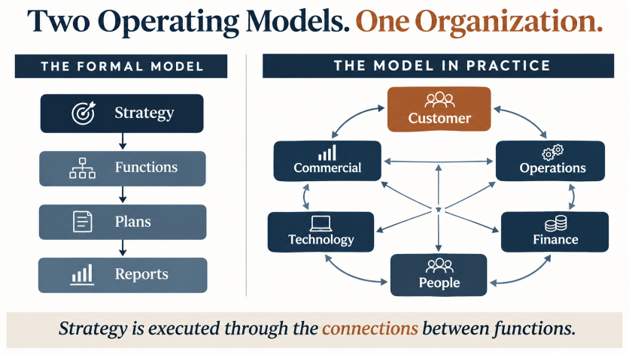
    Comparison of a formal hierarchy of strategy, functions, plans and reports with a connected operating model linking customers, commercial, operations, technology, finance and people.
    Figure 1. Two operating models, one organization. A conceptual illustration of formal structure versus cross-functional execution.

    A documented example: changing the work, not just the labels

    ING’s transformation in the Netherlands offers a useful historical illustration. In a 2017 interview, senior executives described moving commercial and IT colleagues into multidisciplinary squads focused on customer needs, supported by revised roles, governance, technology delivery practices and people systems. The company also distinguished functions that needed independence, such as risk and legal, rather than forcing every activity into the same team design.

    The example is older than the contemporary research used elsewhere in this article, and it should not be read as evidence that every company ought to adopt squads. Its relevance is the breadth of the change. ING’s leaders described not simply a new chart, but a different arrangement of decision-making, work, technical delivery and performance management.

    That is the more general lesson. An operating model cannot be copied as a fashionable structure. It must reflect how the particular enterprise creates value, where coordination is essential and where independence is non-negotiable.

    Five mechanisms that make a strategy executable

    An effective operating model makes five questions answerable in daily work.

    First, where does value actually flow? The organization must understand its critical end-to-end activities, from customer demand to fulfilled promise, rather than optimizing only the steps inside each function.

    Second, who can make which decisions? Authority should sit where the relevant information and consequences can be considered, with explicit escalation for trade-offs that genuinely require enterprise judgment. Clarity matters, but so does the ability to involve the people whose commitments make the choice real.

    Third, how do resources move? Strategy changes priorities, but budgets, specialist capacity and leadership attention often remain anchored to the previous year’s structure. A functioning model creates a way to reallocate scarce resources when enterprise value requires it.

    Fourth, what does performance reward? If business units are measured only on local margins while being asked to share talent or serve common customers, the measures may work against the strategy. Shared outcomes need compatible incentives without eliminating necessary local accountability.

    Fifth, what is the operating cadence? An annual plan and monthly status review are not enough for work that changes weekly. Leaders need recurring forums in which dependencies are exposed, decisions are resolved, commitments are updated and results change the next set of priorities.

    These mechanisms reinforce one another. A clear decision right is of limited use without resource access. Shared metrics are weak if teams cannot act on what they reveal. A cadence becomes bureaucracy if it reports activity but cannot resolve constraints.

    The argument against redesigning everything

    There is a reasonable objection to all this: operating-model redesign can become an expensive distraction. New structures interrupt relationships, create uncertainty and consume leadership capacity. A stable business may perform better by improving a few handoffs than by launching another enterprise transformation.

    That objection deserves to be taken seriously. Not every strategic change requires a new organization chart, a matrix or a cross-functional team for every activity. Some work benefits from specialization, standardized processes and clear hierarchical accountability. Regulated functions may need deliberate separation. Local autonomy may be essential when markets differ.

    The test is not whether the model looks modern. It is whether the mechanisms match the work the strategy requires.

    A targeted intervention may be enough: redesign the interface between sales and operations, create a shared investment decision, alter the allocation of technology capacity, or establish a forum with real authority over an end-to-end customer journey.

    Conversely, when the strategy fundamentally changes how value is created, local fixes may be insufficient. The operating model itself must change. The scale of redesign should follow the scale of the mismatch, not the enthusiasm for reorganization.

    How to see the gap before it becomes a transformation program

    The most useful diagnostic is often not a survey asking whether the operating model is clear. It is an examination of recent work.

    Choose a strategic outcome that requires several functions. Trace one real instance of that work from initiation to delivery. Identify every decision, handoff, resource request, exception and performance measure that influenced its progress. Ask where time was spent and why.

    Then compare the observed path with the path leaders believe the work should follow.

    Did the accountable leader have authority but not resources? Were teams optimizing different definitions of success? Did information arrive too late? Did an exception have to travel three management layers? Was the customer outcome visible to everyone involved, or only to the final team in the chain?

    The answers reveal the actual operating model. They also identify which changes are worth making first.

    McKinsey’s August 2025 analysis of end-to-end processes argues that structural redesign alone can leave underlying work and behaviors untouched. That is a useful caution. The most productive changes often remove unnecessary steps, synchronize dependent activities and simplify the movement of information and decisions, rather than adding another layer of coordination.

    A practical distinction: coordination versus integration

    Not every dependency needs a permanent cross-functional team. Some activities need only a reliable handoff: a standard, a service-level commitment and a clear exception path. Others demand genuine integration because the functions must make simultaneous trade-offs about customers, cost, capacity and risk. Confusing these two situations can make the organization either too fragmented or unnecessarily complicated.

    The distinction can be tested by asking whether one function can complete its work successfully once it receives a defined input, or whether the outcome depends on several functions adapting their choices together. The first calls for a better interface. The second may require shared priorities, joint decision-making and an operating cadence that keeps commitments synchronized.

    The design challenge is therefore selective: integrate where value depends on joint action, preserve functional depth where specialization matters, and avoid turning every interaction into another committee.

    The executive test

    For CEOs, COOs, CSOs and operating partners, I would start with five questions.

    1. Which strategic outcomes require multiple functions to act as one system?
    2. Where do those outcomes encounter recurring handoffs, competing priorities or resource bottlenecks?
    3. Who has the authority and capacity to resolve those issues at the level where they occur?
    4. Do incentives and performance measures reinforce the enterprise outcome or reward local optimization?
    5. What recurring mechanism turns new information into decisions, commitments and adjustments?

    If the answers depend on a handful of executives personally connecting the organization, the operating model may be relying on leadership heroics rather than institutional capability.

    The strategy is not truly embedded when people can repeat its priorities. It is embedded when those priorities shape the ordinary movement of work, resources and decisions without requiring constant exceptional intervention.

    That is why the operating model is not an implementation detail that follows strategy. It is the means through which strategy becomes real.

    The organization’s operating model is revealed not by what its leaders have drawn, but by what its people are able to do together.

    References

    1. McKinsey (June 25, 2025). The new rules for getting your operating model redesign right.
    2. McKinsey (August 27, 2025). Want to break the productivity ceiling? Rethink the way work gets done.
    3. McKinsey (June 18, 2025). A new operating model for a new world.
    4. McKinsey (January 10, 2017). ING’s agile transformation. Historical case interview. https://www.mckinsey.com/industries/financial-services/our-insights/ings-agile-transformation
  • The Cost of an Unmade Decision

    A company is preparing to launch a major new product.

    Commercial leadership wants to move quickly to capture a market opportunity. Operations questions whether production capacity can support the proposed launch. Finance wants greater certainty before releasing investment. Technology has dependencies that must be resolved before the new model can operate at scale.

    Each function has a legitimate position. Each is protecting something important to the business.

    The leadership team discusses the issue. More analysis is requested. A follow-up meeting is scheduled. The decision remains open.

    But the organization does not stop working.

    Commercial continues preparing for the original date. Operations develops alternative capacity plans. Finance holds back funding. Technology proceeds with work that may need to change once the direction is settled.

    Weeks later, the issue returns to the executive agenda.

    By then, people have worked against different assumptions, resources have been committed to competing scenarios, and dependencies have grown more complicated. Some work must be repeated. Other work has not begun. The market opportunity has continued to move.

    Nothing in this illustrative situation necessarily reflects weak leadership or poor judgment. The problem is that the organization has not resolved a decision on which collective progress depends.

    An unmade decision is rarely an isolated event. Its consequences spread through the organization long before anyone calculates what the delay has cost.

    The cost that financial reports struggle to show

    Organizations scrutinize the decisions they make. Investment committees evaluate returns. Boards review strategic choices. Executives assess whether initiatives delivered their promised benefits.

    Decisions that remain unresolved receive far less economic scrutiny.

    A January 2026 West Monroe survey of more than 1,200 US executives and managers found that 73% of respondents estimated their organizations lose up to 5% of annual revenue because of slow decision-making and delayed execution.

    These were respondents’ estimates, not audited financial losses. The research also examined delayed execution broadly, rather than isolating decisions that were never made.

    Nevertheless, the findings highlight an important issue: decision delays are not simply administrative inefficiencies. They can carry significant commercial consequences.

    The cost has several components.

    Delay. A launch, investment, integration milestone or customer commitment cannot advance as planned.

    Duplicated effort. Teams maintain alternatives, commission additional analyses or prepare for competing outcomes.

    Rework. When the decision is finally made, assumptions change and completed work must be revisited.

    Leadership attention. Issues that should be resolved within the operating organization repeatedly consume executive time.

    Foregone value. Benefits arrive later, competitors move first or opportunities disappear entirely.

    These consequences rarely appear together in financial reporting.

    Commercial records a missed date. Operations absorbs additional planning work. Technology writes off effort. Finance sees expected benefits move into the next quarter.

    Each report may be accurate. None necessarily identifies the common cause.

    The cost of indecision is difficult to see precisely because the organization experiences it in pieces.

    What does one unresolved decision actually cost?

    Consider a hypothetical integration decision: whether two acquired businesses should move to a common order-management platform or retain separate systems.

    The decision remains unresolved for eight weeks. During that period, both organizations continue preparing for different possible outcomes.

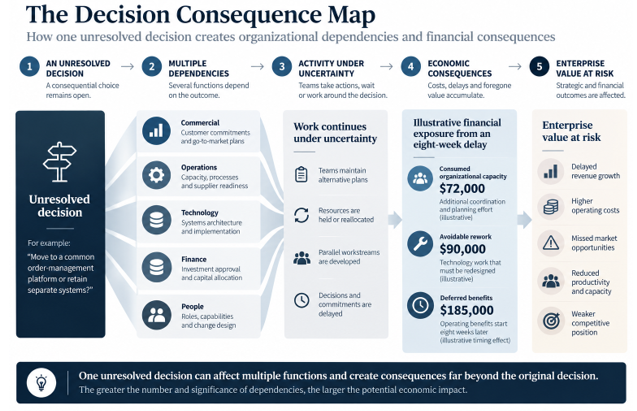
    A 12-person cross-functional team spends an additional six hours per person each week maintaining parallel plans. At an illustrative fully loaded rate of $125 per hour, that represents $72,000 of organizational capacity consumed.

    Technology teams also undertake work that must subsequently be redesigned. Assume $90,000 of that effort could have been avoided had the decision been resolved earlier.

    Meanwhile, an operating improvement expected to deliver $1.2 million annually begins eight weeks later than planned. At a straight-line run rate, approximately $185,000 of expected benefits shifts into a later period.

    These figures are hypothetical, not typical costs or research findings. The illustration assumes the decision could have been made earlier without compromising its quality, and that the cost categories do not overlap.

    The economic distinction matters.

    Staff time represents capacity consumed, not necessarily additional cash spending. Rework may create avoidable costs. Delayed benefits affect timing and may or may not become permanently lost value.

    Yet all three consequences arise from the same unresolved decision.

    And they are likely to appear in different places: staffing reports, technology budgets and financial forecasts.

    The largest consequence may not be the time executives spent discussing the issue. It may be the work the rest of the organization performed around it.

    Why indecision can look like progress

    A company waiting for a decision can appear remarkably busy.

    Meetings continue. Project dashboards show completed activities. Functions pursue their own objectives. Teams prepare contingency plans and report milestones.

    From inside each function, the activity can be entirely rational.

    Commercial is protecting growth. Operations is protecting reliability. Finance is exercising discipline. Technology is managing delivery risk.

    Yet local progress does not necessarily add up to enterprise progress.

    Gartner’s 2024 research found that 84% of surveyed marketing leaders and employees experienced high collaboration drag, involving excessive meetings, feedback loops and unclear decision authority when working across functions.

    The research also found that organizations experiencing high collaboration drag were 37% less likely to achieve their revenue goals.

    The study examined marketing-related cross-functional work rather than enterprise decision-making as a whole. Nevertheless, it illustrates how organizational friction can consume effort without resolving underlying issues.

    More meetings do not necessarily produce alignment. More information does not automatically produce a decision. And more activity does not guarantee forward movement.

    When a consequential choice remains open, teams may optimize against different assumptions. Their individual scorecards can look healthy while the enterprise pays for the inconsistency.

    Why capable leaders cannot always resolve the choice

    It is easy to blame indecision on cautious executives or slow committees. Sometimes that criticism is justified.

    But consequential decisions frequently stall because of conditions built into the organization.

    Competing objectives. A commercial leader is measured on growth, an operations leader on reliability, and a CFO on capital discipline. Each can defend a sensible position. The unresolved question is which trade-off best serves the enterprise.

    Dependencies discovered too late. A decision that appears to belong to one function depends on capacity, systems, people or funding controlled elsewhere. Those dependencies emerge as objections late in the process rather than being resolved while options are developed.

    Authority without readiness. A decision-maker may have formal approval rights but lack the shared information, implementation commitments or organizational support needed to make the choice executable.

    Different interpretations of the objective. Leaders can agree on a strategic ambition while disagreeing about what must change, which risks matter most and what should take priority when resources are constrained.

    The issue moves upward. Additional analysis is requested. Functions defend their positions. The meeting ends without resolving the underlying trade-off.

    The organization is not necessarily short of intelligent people. It may be short of the connections and decision mechanisms that allow those people to act coherently.

    When a systems decision becomes an integration problem

    In an August 2026 article, M&A Integration Discipline Is an Operating System, DLA Piper’s Guy Fisher describes a bolt-on acquisition in which a decision about which technology systems to retain remained unresolved for months.

    An integration owner had been appointed, but cross-functional decision forums and agreed authority levels had not been established.

    The systems decision involved technology, finance, HR and other functions. Without an effective mechanism for resolving their competing requirements, the issue moved sideways and delayed integration.

    The company is unnamed, and the practitioner account does not quantify the financial consequences.

    Appointing an owner did not establish the conditions required for the organization to make and execute the decision.

    The multiplier is dependency, not just time

    A decision’s cost depends on more than the number of days it remains open.

    A minor choice affecting one team may wait for weeks with limited consequences. A decision affecting customer commitments, capital investment, operating capacity and technology priorities can create substantial disruption in a much shorter period.

    I think of this through three lenses:

    Decision delay: How long has the choice remained unresolved, and why?

    Dependency exposure: Which functions, investments, commitments and activities depend on its outcome?

    Execution consequences: What work is delayed, duplicated, misdirected or at risk of losing value?

    Together, these form a practical way to examine the organizational consequences of an unmade decision.

    They are not a validated financial formula. Their purpose is to make dependencies and economic exposure visible before the costs become buried in separate operating reports.

    The more interconnected the decision, the wider its consequences can spread.

    And making the decision does not necessarily erase the costs already incurred through workarounds, incompatible assumptions and delayed commitments.

    The executive question is therefore not simply, How long has this decision been open?

    It is:

    How much of the organization is working around the fact that it remains unresolved?

    Decision Consequence Map showing an unresolved choice cascading through cross-functional dependencies and work under uncertainty to illustrative delay costs and enterprise value at risk.
    Figure 1. The Decision Consequence Map. Illustrative consequences of an eight-week decision delay. Capacity consumed, avoidable rework and deferred benefits are distinct forms of economic exposure, not equivalent financial losses.

    Waiting can be the right decision

    Speed is not an end in itself.

    A safety-critical change may require further testing. An acquisition may warrant additional diligence. A major investment may benefit from waiting for information that could materially alter the choice.

    A meta-analysis by Kolev and colleagues, published in the February 2025 issue of Journal of Management Scientific Reports, synthesized 127 empirical studies and found positive overall associations between firm performance and decision speed, implementation speed and competitive response speed.

    The researchers also identified contextual factors affecting those relationships.

    The evidence supports the value of effective speed. It does not establish that faster decisions always produce better outcomes.

    The distinction is between deliberate deferral and organizational indecision.

    Deliberate deferral has a named owner, a specific reason for waiting, clear evidence requirements, a decision date or trigger, and an understanding of what the delay costs.

    Indecision looks different.

    The same issue returns repeatedly. More analysis is commissioned without agreement on what would be sufficient. Functional positions remain fixed. No one can explain what must change for a decision to be made.

    Time passes without improving the organization’s ability to choose.

    Engineered alignment: from authority to execution capacity

    The conventional response to decision bottlenecks is to clarify decision rights: define who recommends, who contributes, who approves and who is accountable.

    That matters.

    But a name in a decision matrix does not automatically resolve competing priorities or make implementation possible.

    A leader can approve a direction while the people responsible for carrying it out still hold different assumptions, face unresolved dependencies or lack the capacity to deliver.

    Decision authority answers who can choose. Execution capacity determines whether the organization can act on that choice.

    Engineered alignment connects the two.

    It brings the relevant leaders and functions into a shared understanding of enterprise priorities. It makes dependencies and trade-offs explicit before they surface as implementation failures.

    It establishes who must decide, what information and participation are necessary, what the decision commits each function to do, and how unresolved issues will be surfaced and resolved.

    The aim is not consensus on everything.

    Complex organizations will always contain legitimate differences in perspective. The objective is to make those differences visible, resolve their implications and establish a coherent course of action.

    That changes the role of senior leadership.

    Executives still make the consequential choices that belong to them. But they need not personally reconcile every cross-functional conflict or repeatedly arbitrate the same issue.

    More decisions can be prepared, made and implemented through the organization’s established connections and operating cadence.

    Alignment is therefore not a workshop outcome or a statement of shared intent.

    It is an ongoing organizational capability: the ability to convert strategic direction into decisions, commitments and coordinated execution as conditions change.

    The executive test: what remains undecided?

    Start with the three unresolved decisions that most constrain your current strategic priorities.

    For each, ask:

    1. What exactly remains undecided? Can the issue be expressed as a specific choice rather than a broad problem?
    2. Who and what depends on it? Which teams, investments, customer commitments or initiatives are proceeding under uncertainty?
    3. What is happening while we wait? Where are we duplicating effort, delaying benefits or committing resources against assumptions that may change?
    4. What prevents resolution? Are we waiting for evidence that will improve the choice, or have we failed to reconcile priorities, dependencies or authority?
    5. What makes the decision executable? Who must participate, who has final authority, and what commitments and follow-through are required?

    The answers reveal more than overdue decisions.

    They show where coordination is failing, where execution capacity is being consumed, and where senior leadership has become the default mechanism for holding the organization together.

    A company can have a clear strategy, capable leaders and well-funded initiatives yet still struggle to deliver because the decisions connecting them remain unresolved.

    The most expensive decisions may not be the ones that turn out to be wrong. They may be the ones the organization never quite manages to make.

    References

    1. West Monroe (January 27, 2026). Why Speed Matters: The Competitive Advantage of Faster Business Decisions.
    2. Gartner (May 14, 2024). Gartner Survey Reveals 84% of Marketers Report Experiencing High Collaboration Drag From Cross-Functional Work.
    3. Fisher, Guy (August 27, 2026). M&A Integration Discipline Is an Operating System. DLA Piper.
    4. Kolev, K. D., Dykes, B. J., Kang, S., Hughes-Morgan, M., and Ferrier, W. J. (2025). Fast or Slow? A Meta-Analysis on the Performance Implications of Decision, Implementation, and Response Speed. Journal of Management Scientific Reports, 3(1), 40–67.
  • The Strategy Is Clear at the Top. Is It Clear Everywhere Else?

    Steven Saunders · Strategy Execution

    Why strategy execution depends on engineering alignment throughout the organization.

    A leadership team can spend months developing a strategy, reach genuine agreement on the direction of the business, and still struggle to execute.

    The priorities are clear. Financial objectives have been established. Accountability has been assigned. The plan has been communicated.

    Business units develop their objectives. Functions establish their initiatives. Managers translate those initiatives into operating plans.

    Everyone gets to work.

    Six months later, the executive team finds itself spending an increasing amount of time reconciling priorities, resolving conflicts and intervening in work that should be progressing.

    The familiar explanations emerge. Communication needs to improve. Accountability needs to be strengthened. People need to collaborate more effectively.

    Sometimes those explanations are correct.

    But consider another possibility.

    The organization has never developed a sufficiently shared understanding of what the strategy requires its different parts to accomplish together.

    People may understand the direction. They may agree with it. They may be working hard against objectives that appear consistent with the plan.

    Yet their efforts do not necessarily reinforce one another.

    The organization may be aligned vertically, with each function pursuing its assigned objectives, without being aligned horizontally around the work required to deliver the strategy.

    That distinction is consequential.

    It explains why capable people, clear responsibilities and disciplined performance management can coexist with disappointing execution.

    And it points toward a different way of thinking about organizational alignment.

    Alignment can be engineered into the way the business operates, reducing the need for senior leaders to continually reconnect priorities and resolve dependencies.

    A strategy can be clear without being operational

    In July 2013, Microsoft announced a major organizational realignment under the banner of One Microsoft.

    The company had built enormously successful businesses around products such as Windows, Office and Xbox. But its strategic direction increasingly depended on delivering connected experiences across devices, applications and services.

    That required more than successful individual businesses.

    It required those businesses to work together.

    In his announcement, Steve Ballmer described changes to Microsoft's organizational structure, planning, resource allocation and collaboration. The company would move toward shared goals, more integrated engineering activities and cross-company teams responsible for major initiatives.

    Importantly, the announcement also recognized the need to empower employees closer to customers to make decisions consistent with the broader strategy.

    This was not simply an effort to communicate a new direction.

    Microsoft was changing aspects of how the organization worked because its strategic ambition depended on capabilities that its existing arrangements did not consistently support.

    When Satya Nadella became CEO in 2014, Microsoft's transition toward cloud services accelerated.

    Research published by MIT's Center for Information Systems Research later documented how Microsoft consolidated core commercial functions and changed employee performance assessments to place greater emphasis on collaboration across the organization.

    Microsoft's transformation involved many factors. It would be misleading to attribute its subsequent success to organizational alignment alone.

    But the case illustrates an important principle.

    When strategy changes what an organization must accomplish, it may also change how its people, functions and operating activities need to work together.

    The challenge extends well beyond technology.

    A manufacturer shifting from individual products to integrated customer solutions must connect commercial, engineering, production and service activities differently.

    A private-equity-backed platform integrating acquisitions must reconcile businesses that previously operated independently.

    A healthcare organization redesigning its service model must coordinate clinical, operational, administrative and technology responsibilities around a different patient experience.

    In each case, leadership can establish the direction.

    The organization must still develop the capability to execute it together.

    Communication does not establish shared understanding

    Most organizations invest considerable effort in communicating strategy.

    Executive presentations, town halls, leadership meetings, business-unit plans, performance objectives and dashboards all play a role.

    But communicating a strategy is not the same as establishing a shared understanding of how to execute it.

    Research by Donald Sull, Rebecca Homkes and Charles Sull, published in Harvard Business Review in 2015, found that only half of the middle managers surveyed could name even one of their organization's top five strategic priorities.

    That finding should concern any executive team.

    But even an accurate understanding of the priorities is only the beginning.

    Consider a company pursuing profitable growth.

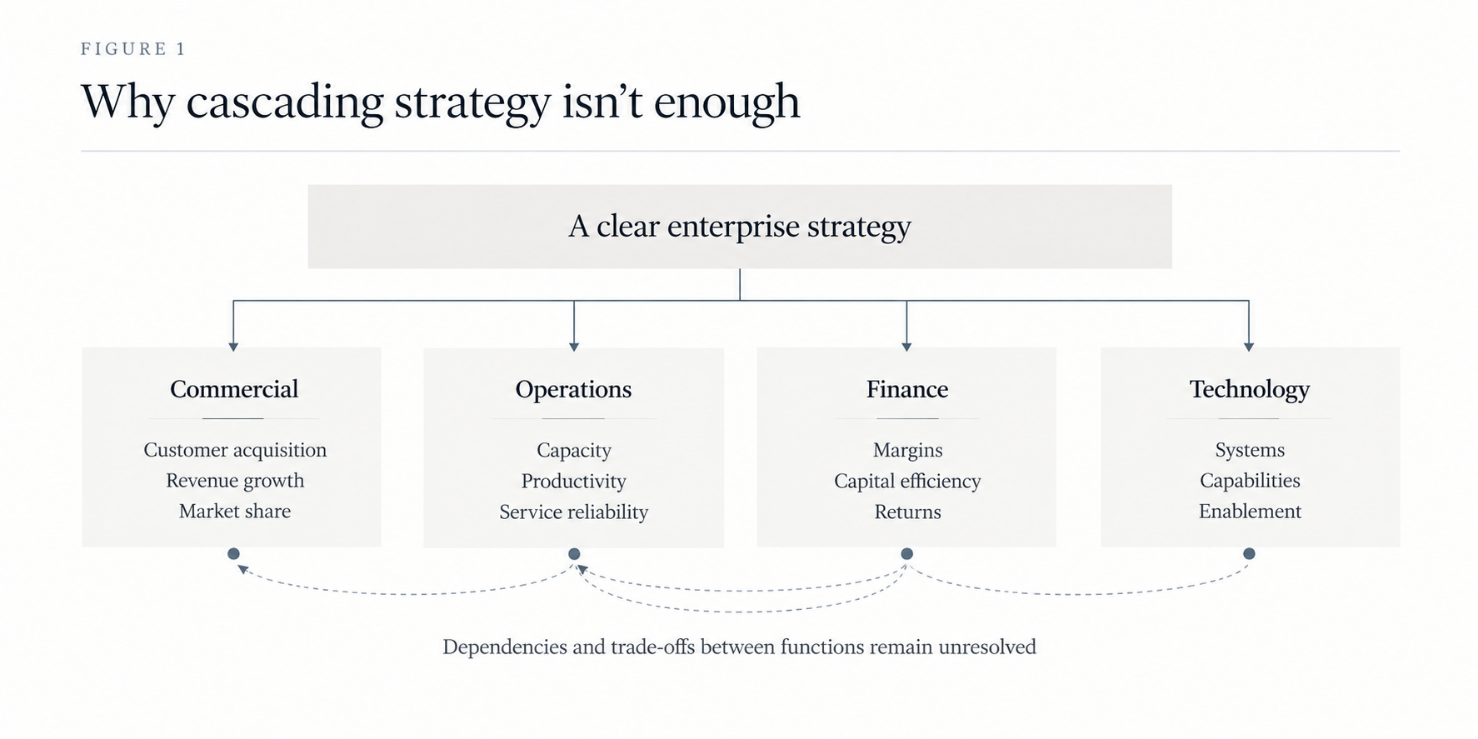
    The commercial organization interprets the strategy through customer acquisition, revenue expansion and market share.

    Operations focuses on capacity, productivity and service reliability.

    Finance emphasizes margins, capital efficiency and returns.

    Technology concentrates on the systems and capabilities required to support growth.

    None of these interpretations is inherently wrong.

    The difficulty emerges when the work of one function depends on decisions and commitments made by another.

    Sales pursues a strategically important customer opportunity that requires additional operating capacity. Operations has committed its resources against an efficiency plan. Finance evaluates the investment against near-term margin expectations. Technology has already prioritized other enterprise initiatives.

    Each function may be acting responsibly within its own objectives.

    But those objectives have not been reconciled into a coherent operating plan.

    The organization understands the ambition without sharing an understanding of how to deliver it.

    This is why alignment must go beyond awareness of strategic priorities.

    People need to understand what the strategy means for their work, what must change, where their responsibilities intersect with others and how competing demands will be resolved.

    A strategy is not operational simply because people know what it says. It becomes operational when they understand what it requires them to accomplish together.

    The limits of cascading objectives

    Diagram showing enterprise strategy cascading to commercial, operations, finance and technology functions while dependencies and trade-offs remain unresolved.

    Most large organizations translate strategy into action through some form of cascading process.

    Enterprise priorities become business-unit objectives. Those objectives become functional plans, team commitments and individual accountabilities.

    There is a sound logic to this approach.

    It creates a connection between strategic direction and local responsibility.

    But organizations are generally managed vertically, while much of the work required to execute strategy happens across horizontal boundaries.

    A product launch depends on development, manufacturing, commercial, distribution and customer support.

    An acquisition integration depends on coordinated decisions across finance, operations, technology, human resources and the acquired businesses.

    An enterprise transformation may require changes across functions that have different leaders, performance measures and priorities.

    Each function can develop a plan that is consistent with the strategy.

    That does not mean the plans are consistent with one another.

    Sull and his colleagues identified this distinction in their research. Organizations often have relatively effective mechanisms for aligning objectives up and down the hierarchy, yet struggle with coordination across organizational units.

    The consequences are familiar.

    Commitments are made without fully understanding dependencies. Resources are allocated against competing assumptions. Decisions are delayed. Work is duplicated. Problems move upward because the people responsible for delivery cannot resolve them within their existing arrangements.

    Senior leaders compensate.

    They convene meetings, negotiate trade-offs, intervene in disputes and reconnect activities that should already be working together.

    Some of this is unavoidable, particularly during significant change.

    But when executive intervention becomes the normal mechanism through which the organization coordinates its work, it reveals something important.

    The organization is relying on leadership effort to compensate for an alignment capability it has not developed.

    That becomes increasingly difficult to sustain as the business grows, diversifies or becomes more complex.

    The people executing the strategy must help make it executable

    The executive team is responsible for establishing strategic direction.

    But it does not possess all the knowledge required to determine how that direction can be executed.

    A regional leader understands market conditions that may not be visible at headquarters.

    A plant manager understands capacity constraints and operating dependencies that are not apparent in a financial plan.

    A commercial leader understands customer commitments that affect production, delivery and service.

    A technology leader understands the sequencing and architectural constraints behind an apparently straightforward operating change.

    These perspectives are not implementation details to be addressed after the plan has been finalized.

    They help determine whether the plan is executable in the first place.

    This is why organizational alignment must extend beyond the C-suite.

    It must reach the levels at which work is organized, commitments are made and dependencies become real.

    That does not mean involving every employee in every strategic decision.

    It means bringing together the people whose knowledge, responsibilities and commitments are essential to delivering the intended outcomes.

    Their work must be connected.

    A manufacturing leader needs to understand the commercial commitments that will affect capacity.

    The commercial organization needs to understand the operating constraints that matter and those that can be changed.

    Finance needs to understand the investment implications of those commitments.

    And the people responsible for delivery need clarity about priorities, decision authority and the contributions required from others.

    The result should be more than a collection of functional plans.

    It should be a coherent operating agenda, developed with enough understanding of the actual organization to make execution possible.

    Alignment can be engineered

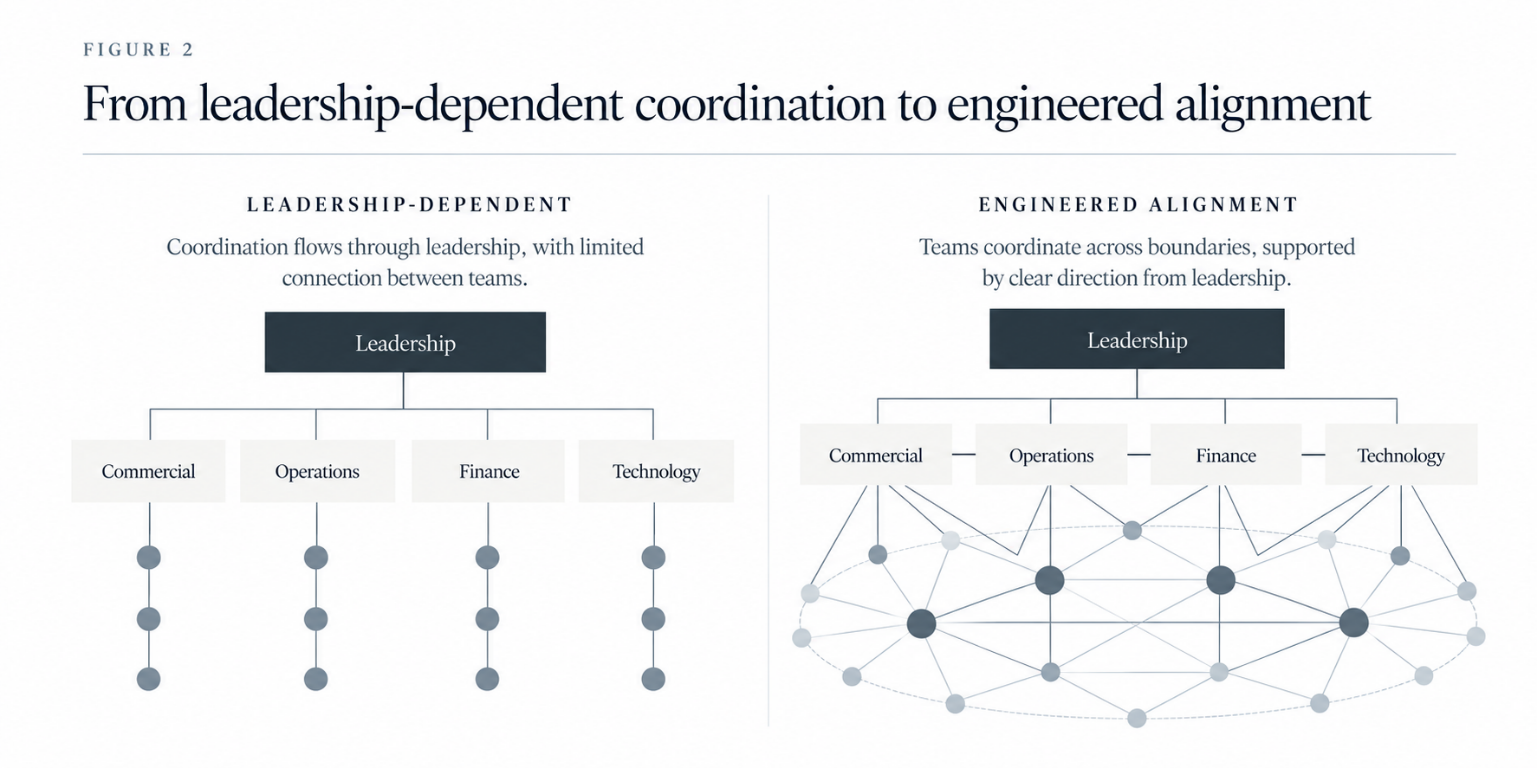
    Comparison of leadership-dependent coordination with engineered alignment across functions.

    Alignment is often treated as a leadership responsibility: something executives create through communication, persuasion and intervention.

    Leadership remains essential. But a strategy that depends on executives continually coordinating its execution has not become an organizational capability.

    The more demanding objective is to build that capability into how the business works.

    That is what I mean by engineered alignment.

    It is the deliberate establishment of conditions that allow people throughout a business to understand a common direction, connect their responsibilities, reconcile dependencies and act coherently without constant executive intervention.

    It is not a call for more governance, more committees or a more elaborate planning process.

    The work is to make the connections required for execution explicit, usable and sustainable.

    That begins with a common understanding of the strategy and the choices behind it.

    It requires translating strategic priorities into work that people can understand and act upon.

    It requires making the dependencies between that work visible, particularly where different functions, business units or operating levels must contribute to the same outcome.

    It requires resolving conflicting priorities, decisions and resource commitments before they repeatedly disrupt execution.

    And it requires establishing ways for people to coordinate, track collective progress and adapt as circumstances change.

    These conditions are interconnected.

    Understanding without coordination produces well-informed teams working independently.

    Accountability without shared commitments can encourage local optimization at the expense of enterprise outcomes.

    Coordination without clear priorities can generate activity without direction.

    And a plan that cannot adapt may become less relevant even as teams execute it faithfully.

    The objective is not to create more organizational activity around strategy.

    It is to build the capability to execute it.

    This becomes particularly important during transformations, acquisitions, integrations, restructurings and operating-model changes.

    These situations alter relationships between parts of the business.

    Responsibilities shift. Established assumptions no longer hold. Priorities compete. New dependencies emerge.

    A plan developed exclusively at the top cannot anticipate every consequence.

    Nor should the organization have to discover each unresolved dependency through a failure in execution.

    Engineered alignment makes those connections explicit and enables the people responsible for the work to resolve them deliberately.

    The result is an organization better equipped to sustain alignment through its normal operations, rather than relying on leaders to recreate it each time priorities collide.

    Alignment does not mean conformity

    There is a legitimate risk in emphasizing alignment.

    Taken too far, it can become a demand for consensus, uniformity or centralized control.

    That would make many organizations less effective.

    A global business may need different approaches across markets. A diversified enterprise may benefit from different operating models. Frontline managers need discretion to respond to customers and changing conditions.

    The objective is not to eliminate these differences.

    It is to establish clarity about what must be common, what can remain different and where coordination is essential.

    Some decisions can remain local because their consequences are largely contained.

    Others require coordination because they affect shared resources, strategic priorities, customer outcomes or commitments made by other teams.

    The organization needs to distinguish between them.

    That is why engineered alignment should reduce unnecessary intervention, not increase it.

    When people understand the strategy, their responsibilities and the boundaries within which they can act, they should be able to make more decisions without seeking approval.

    When dependencies are understood, teams should be able to coordinate directly rather than continually escalating issues.

    When priorities are genuinely shared, the organization should be better equipped to adapt without losing coherence.

    The goal is not to make everyone operate in the same way. It is to enable different parts of the business to act with autonomy while contributing to a common outcome.

    That is a more demanding form of alignment than agreement around a strategy presentation.

    It is also more valuable.

    An executive test: Does the organization share the same plan?

    There is a practical way to examine whether a strategy has become operational throughout a business.

    Select one of the organization's most important strategic priorities.

    Choose something that requires meaningful change or coordination across several functions or operating levels.

    Then speak separately with the people responsible for delivering it.

    Not only the executive sponsor, but business-unit leaders, functional managers and people closer to the work.

    Ask them to explain what the priority is intended to achieve.

    Ask what must change in their part of the business.

    Ask which other teams they depend on, what those teams have committed to deliver and where the critical risks or conflicts sit.

    Ask which decisions they can make independently, which require coordination and how competing priorities will be resolved.

    Finally, ask how they will know whether the collective effort is working and what they will do when circumstances change.

    The purpose is not to test whether people can repeat the language of the strategy.

    It is to discover whether their answers describe the same operating agenda.

    Do they share an understanding of the intended outcome?

    Do their commitments fit together?

    Are the dependencies visible to the people responsible for managing them?

    Have important trade-offs been resolved?

    Can they act without repeatedly returning to the executive team for direction?

    The answers may reveal that the organization is better aligned than leadership assumes.

    They may also expose different interpretations of priorities, incompatible commitments or dependencies that nobody has taken responsibility for resolving.

    Both findings are valuable.

    This is not a substitute for financial performance measures or execution dashboards. It is a way to examine an organizational capability that those measures do not fully reveal.

    It tests whether people understand not only their own responsibilities, but also how the organization must work together to deliver the strategy.

    And if every difficult question ultimately returns to the executive team, the issue may be less about individual accountability than about how the organization has been designed to execute.

    The real test is whether the organization can move together

    A clear strategy is essential.

    So are capable leaders, sound decisions, accountability and disciplined execution.

    But none of these, individually, guarantees that the different parts of an organization will work together effectively.

    That requires shared understanding, connected priorities, reconciled dependencies and the ability to coordinate and adapt across organizational boundaries.

    It requires alignment that reaches beyond the executive team and becomes part of how the organization operates.

    In complex businesses, that level of coordination cannot depend on senior leaders personally connecting every activity and resolving every conflict.

    Engineered alignment develops the shared understanding, working relationships and decision clarity that allow people to act together.

    One approach relies on leaders to keep the organization connected.

    The other develops an organization capable of staying connected.

    The next time an executive team declares itself aligned on the strategy, there is a more revealing question to ask:

    If we stepped back from the daily coordination, escalation and intervention, would the organization still know how to execute the plan together?

    If the answer is no, leadership may be aligned.

    But the organization is not yet engineered to execute.

    Research and references

    Steve Ballmer, One Microsoft: Company realigns to enable innovation at greater speed, efficiency, Microsoft, July 11, 2013. [Source]

    Barbara H. Wixom and others, Achieving Data-Driven Transformation at Microsoft, MIT Center for Information Systems Research, 2017. [Source]

    Donald Sull, Rebecca Homkes and Charles Sull, Why Strategy Execution Unravels—and What to Do About It, Harvard Business Review, March 2015. [Source]

  • How Organizations Move Together: Lessons from Birds and Fish

    A flock of birds turns across the sky. A school of fish changes direction underwater.

    No memo. No governance meeting. No 47-item tracker. No deck.

    Just movement.

    Both images capture something organizations often struggle to achieve: many parts adjusting together without every move passing through a central decision-maker.

    The connections make the movement possible.

    When the organization absorbs the message

    In many organizations, a decision gets made at the top and travels down through layers.

    Each layer interprets it. Each function adapts it to its own reality.

    By the time it reaches the people who have to act, the original intent may have changed shape.

    Not because people ignored it.

    Because they had to make it fit an operating reality the people setting direction could not fully see.

    The strategy called for speed. The organization needed to resolve dependencies.

    The plan assumed capacity. The teams were already committed elsewhere.

    The direction was clear. The trade-offs were not.

    So the organization absorbs the message without moving together.

    Build the connections that make speed possible

    Organizations do not become coordinated simply because leadership asks them to move faster.

    They need people to understand how their work connects.

    Which decisions affect another function. What a shift in one area means elsewhere. Where priorities compete. Who can resolve a trade-off, and when it needs to move upward.

    That understanding allows people to act with greater confidence.

    They can see what others need from them. They know which commitments depend on action elsewhere. They can adjust without waiting for someone senior to reconnect the work.

    The organization becomes less dependent on repeated intervention to maintain momentum.

    That is the useful lesson in the flock of birds and the school of fish.

    Coordinated movement depends on connections built before the turn.

    Leaders still set the direction

    Organizations need explicit leadership, authority and accountability. Neither metaphor is a complete management model.

    Leaders set direction. They define the boundaries within which people can act. They make consequential trade-offs and decide when the whole organization needs to move somewhere new.

    But they cannot personally carry every dependency, handoff and cross-functional decision.

    The strongest leaders build conditions in which people can coordinate without leadership being everywhere.

    That requires clarity upfront. Trust in the people carrying the work. Discipline about decision authority. And judgment about when intervention is necessary.

    Build shared understanding before asking for movement

    In an enterprise transformation, this means connecting the functions and operating layers whose work must change together.

    In an acquisition, it means resolving how people across the combined business will make decisions, handle dependencies and carry shared priorities.

    In a PE-backed company, it means turning the value creation plan into commitments understood and owned beyond the executive team.

    The starting point is bringing the right people together to work through the real constraints.

    They help shape the actions. Surface competing demands. Resolve assumptions. Understand how their commitments connect to everyone else’s.

    Then, when conditions change, they have a shared basis for adjusting.

    A new priority does not have to be translated from scratch through every layer. A dependency does not have to wait until it becomes a crisis before the people involved speak directly.

    The understanding is already there.

    Direction at the top. Movement across the organization.

    The best leaders are not the ones who are everywhere.

    They are the ones who build something that can move without them being everywhere.

    Corporate strategies, transformation agendas and private equity value creation plans all require that capability.

    Leadership calls the direction.

    The people carrying execution understand what the turn means for their work, how it affects others and which decisions they can make.

    They move together because the connections, clarity and ownership were built into the way the organization works.

    Whether we picture birds turning across the sky or fish moving through the water, the lesson for organizations is the same.

    The speed we notice is the result.

    The connections are what make it possible.

    Related thinking: Leadership Alignment Is Not the Endpoint · The Co-Creation Paradox

    Back to Thinking →

  • When Strategic Initiatives Compete Instead of Compound

    A strategy can be sound and still arrive in the wrong order.

    The initiatives are logical. The targets make sense. Each decision is defensible on its own.

    Yet execution falls short.

    Sometimes the issue is not what the organization is being asked to do. It is when those demands hit the business, and what needs to be ready before they can work.

    This applies to a corporate transformation just as much as a private equity value creation plan.

    Organizations execute through shared people, shared resources and finite decision bandwidth.

    Initiatives do not land in isolation.

    Good decisions can undermine one another

    Consider a few familiar situations.

    Replacing the VP of Sales before resolving the positioning problem.

    Raising prices before strengthening the articulation of customer value.

    Pushing cross-sell before the teams are equipped to deliver it.

    Each action may have merit. But in the wrong order, one can weaken the next.

    The new sales leader inherits a problem a leadership change cannot resolve alone. Customers face a price increase before they understand the value. Commercial teams make commitments the operating teams are not ready to fulfill.

    Activity increases. Results disappoint. Leadership questions the initiative or the people carrying it.

    But the sequence may be the constraint.

    Sequencing is more than a timeline

    A project plan can show milestones without showing whether the organization is ready to meet them.

    Dates tell us when we want something to happen.

    Dependencies tell us what must happen first.

    Capacity tells us whether the people carrying the work can absorb it alongside everything else.

    Those are different questions.

    In an enterprise transformation, several functions may launch changes against the same timeline while depending on the same technology team.

    In a PE-backed company, a value creation plan may combine pricing, commercial improvement, integration and systems changes, each with its own owner.

    Individually, the plans look workable.

    Together, they can overload the organization.

    Three questions before the next initiative starts

    Sequencing requires an honest assessment of three things.

    Foundational capabilities

    What must exist for the next step to work?

    A growth initiative may depend on delivery capacity. Cross-sell may depend on shared customer information, incentives and a clear handoff between teams.

    Starting before those foundations exist can create rework rather than momentum.

    Hard dependencies

    Which decisions or commitments must be resolved first?

    A dependency is not fully managed because someone has listed it in a tracker. The people on both sides need to understand what is required, who owns it and when it will be available.

    Otherwise, one team’s progress rests on another team’s unconfirmed assumption.

    Capacity to absorb change

    Where can the organization realistically take on more?

    The same people may be carrying business-as-usual demands, an acquisition and several transformation initiatives.

    A new priority does not create new capacity.

    Something may need to stop, move later or change scope for the next commitment to be credible.

    Build the sequence with the people who know the constraints

    Leadership sets the ambition and the non-negotiables.

    The people carrying execution help establish the sequence that makes delivery possible.

    They know where initiatives compete for the same resources. Which capabilities are not ready. Which handoffs are fragile. What a delay in one area will mean elsewhere.

    Bringing those realities together early allows the organization to make trade-offs before they become missed milestones.

    Some work accelerates. Some waits. Some changes shape.

    That is disciplined execution: creating the conditions for each initiative to strengthen the next.

    Make initiatives compound

    When sequencing is right, progress in one area enables progress in another.

    A capability is built before the initiative that depends on it. A decision is resolved before teams commit resources. Capacity is released before another demand arrives.

    When sequencing is wrong, initiatives compete.

    Teams work harder. Dependencies remain unresolved. Leadership spends more time intervening. The organization carries more activity than it can convert into results.

    The useful question is not simply, “What should we do next?”

    It is, “What needs to be true for the next step to work?”

    For corporate leaders and private equity investors alike, that question connects strategic ambition to operating reality.

    The order is part of the strategy’s ability to become action.

    Related thinking: Accountability Is Not Clarity · The Co-Creation Paradox

    Back to Thinking →

  • Leadership Alignment Is Not the Endpoint

    Leadership alignment is essential.

    But it should not be the endpoint.

    You can have a fully aligned leadership team and still have little coordinated movement underneath it.

    Everyone agrees on the priorities. The strategy is clear. The board and management are on the same page.

    From the top, it looks exactly how it should.

    But execution happens across the organization, where teams, functions and priorities meet the reality of the work.

    That is where alignment gets tested.

    Agreement does not resolve dependencies

    A leadership team can agree to accelerate growth, integrate an acquisition or transform the operating model.

    That agreement establishes direction.

    It does not automatically resolve what happens when commercial priorities depend on technology capacity, operational changes require finance decisions, or several initiatives need the same people.

    Different functions can support the same strategy while interpreting its implications differently.

    Each team progresses against its own objectives. Updates show activity. Leadership remains confident in the direction.

    Yet progress across the organization is uneven.

    Some initiatives move. Others stall. Many slow down as they cross functions.

    Because leadership is aligned, the friction can be easy to overlook.

    Execution just feels harder than it should.

    The false sense of control

    Agreement at the top can create confidence that the organization is ready to deliver.

    But there is a difference between leaders sharing a direction and the people carrying the work sharing an executable plan.

    In an enterprise transformation, functional leaders may endorse the same ambition while their teams work from different assumptions about sequencing, resources and decision authority.

    In a PE-backed company, the sponsor and management team may agree on the value creation plan while the operating layers remain unclear about how competing initiatives fit together.

    Nobody has to disagree with the strategy for execution to slow.

    The organization may simply lack a shared way to resolve the decisions and dependencies the strategy creates.

    Move alignment into the work

    The response is often more communication.

    Another leadership session. Another presentation. Another reinforcement of the priorities.

    Those can help when direction is unclear.

    But when people already understand the direction, repeating it does not resolve the trade-offs they face.

    The work needs to move closer to the people carrying execution.

    Bring the relevant functions and operating layers together to resolve:

    • What the priorities mean for their actual work.
    • Which commitments depend on action elsewhere.
    • Where resources or initiatives compete.
    • Who can make the decisions that cross boundaries.
    • How ownership and accountability connect across teams.

    This is where organizational alignment becomes practical.

    People leave with more than agreement on the ambition. They understand what they are carrying together, what others need from them and how the work will move.

    Alignment has to hold as conditions change

    That understanding cannot remain fixed while the business changes around it.

    An acquisition introduces new dependencies. A customer requirement changes the sequence. A resource constraint forces a trade-off.

    An operating cadence needs to bring those changes back into the shared plan, so teams can adjust together.

    Otherwise, each function adapts locally. Individually reasonable decisions begin to pull the organization in different directions.

    Leadership may remain aligned throughout.

    The work underneath can still drift.

    The endpoint is coordinated action

    Leadership alignment gives the organization direction.

    Organizational alignment connects that direction to the decisions, commitments and dependencies required to deliver it.

    Corporate leaders, sponsors and portfolio company executives need both.

    The useful test is what happens after the leadership meeting ends.

    Can the people carrying execution move together?

    Can they resolve trade-offs with clear authority?

    Do their commitments connect across functions and levels?

    And does that coordination hold when conditions change?

    Agreement at the top is a necessary beginning.

    The endpoint is an organization that can act on it.

    Related thinking: The Co-Creation Paradox · When Execution Depends on Leadership Presence

    Back to Thinking →

  • When Execution Depends on Leadership Presence

    There is a point in many organizations where execution starts to feel heavier than it should.

    Not because the strategy is wrong. Not because the team lacks capability.

    But because progress starts to depend on leadership being in the room.

    Decisions move when the CEO is present. Initiatives accelerate when the sponsor or transformation leader leans in. Cross-functional issues get resolved when someone senior steps in to connect the dots.

    And when they are not there, things slow down.

    Not dramatically. Just enough to notice.

    Intervention becomes the operating model

    Priorities do not translate as clearly across functions. Dependencies sit unresolved a little longer. Teams keep working, but their efforts do not always connect.

    So leadership compensates.

    More check-ins. More direct involvement. More time spent making sure things move the way they are supposed to.

    At first, it feels necessary. Even effective.

    A senior leader can make the call, resolve the conflict and get an initiative moving again.

    But over time, that intervention becomes the operating model.

    Execution is being carried by leadership presence rather than by the organization’s ability to coordinate the work.

    Why the problem is easy to miss

    This does not look like failure.

    The business may still be performing. The strategy remains intact. Individual teams are delivering against their objectives.

    Yet progress across the organization requires someone senior to keep reconnecting those efforts.

    In an enterprise transformation, the same executive may repeatedly resolve competing demands between technology, operations, finance and commercial teams.

    In a PE-backed company, the CEO or operating partner may become the link holding the value creation plan together.

    Their involvement produces movement. But the organization has not yet developed a reliable way to sustain that movement without them.

    That is the moment that matters.

    Because the problem is easy to mistake for strong leadership.

    Leadership bandwidth becomes the constraint

    Every additional initiative introduces more dependencies. Every new acquisition, geography or operating model change creates more decisions that cross organizational boundaries.

    And every push forward requires more direct involvement to keep the work connected.

    That does not compound. It plateaus.

    Leadership bandwidth becomes the constraint.

    The person carrying coordination has finite time. Decisions queue behind their availability. Teams learn to wait for intervention because intervention is how difficult issues get resolved.

    The organization can keep moving, but acceleration becomes expensive to sustain.

    Momentum has to be recreated every time.

    Build the conditions for decisions to move

    The instinct is to lean in further.

    More oversight. More meetings. More pressure.

    Those actions may help an immediate issue. They do not, on their own, change how the next issue will be handled.

    The underlying work is to resolve what leadership keeps carrying manually:

    • Which priorities take precedence when demands collide.
    • Who owns outcomes that cross functions.
    • Where decisions can be made, and when escalation is necessary.
    • How dependencies are understood by the people on both sides.
    • What operating cadence keeps commitments connected as conditions change.

    These cannot remain assumptions in a strategy deck.

    They need to be worked through by the people whose actions depend on one another.

    When those connections are clear, teams can resolve more of the work directly. Leadership can focus on direction, consequential trade-offs and the decisions that genuinely require its authority.

    Momentum that holds

    Leaders still need to intervene. Some decisions belong at the top. Some situations require a reset.

    The question is whether intervention is helping the organization through an exception, or compensating for the same unresolved coordination problem every week.

    Corporate strategies and private equity value creation plans both depend on the organization’s ability to carry decisions into action.

    If execution depends on constant leadership presence, it will struggle to scale.

    The difference is between momentum that holds across the organization and momentum that has to be recreated whenever someone senior walks into the room.

    Related thinking: Accountability Is Not Clarity · The Co-Creation Paradox

    Back to Thinking →

  • Accountability Is Not Clarity

    Accountability is not clarity. It never was.

    But most organizations treat them as the same thing.

    Performance stalls. Leadership asks who owns it. A name gets added to the tracker. A governance cadence gets built around it. The RACI gets updated.

    And the problem stays exactly where it was.

    Because naming an owner does not tell that person what delivering the outcome actually requires.

    What accountability assumes

    The person carrying the work needs to understand:

    • What success looks like.
    • Which decisions are theirs to make.
    • Which dependencies they need to resolve.
    • What trade-offs they will face.
    • What they need to stop doing to make room for the work.

    Without those answers, accountability can become a blame distribution system.

    The named owner shows up to the review. They report progress because the alternative is uncomfortable. They manage the metric because the metric is what gets reviewed.

    And the work the metric was supposed to represent barely moves.

    Not necessarily because the person lacks capability or commitment.

    Because they were handed accountability without the clarity needed to act.

    The accountability illusion

    The org chart shows owners. The tracker shows green. The governance cadence shows attendance.

    Yet somewhere below the executive team, a critical constraint remains unresolved.

    A commercial leader owns growth, but delivery depends on operational capacity nobody has committed.

    A transformation lead owns a milestone, but the people needed to deliver it are already carrying three other priorities.

    A portfolio company executive owns a value creation initiative, but decisions cross functions whose responsibilities were never resolved.

    Each has a name beside the outcome. None has a fully workable path to delivering it.

    That is the accountability illusion.

    The plan has owners. It does not yet have clarity.

    Build clarity with the people carrying the work

    Real clarity means understanding more than the target.

    It means understanding the dependencies, the trade-offs, the decisions that can be made without escalation and the friction likely to appear before senior leadership sees it.

    That understanding cannot be created through a briefing alone.

    It has to be built with the people carrying the work, including those whose decisions and resources determine whether it can move.

    This is where the important conversations happen.

    Which priority wins when two initiatives need the same team?

    Who can resolve a trade-off across functions?

    What can the owner decide directly, and what requires escalation?

    What must change elsewhere in the organization for this commitment to be credible?

    Those questions connect accountability to operating reality.

    Clarity before pressure

    In an enterprise transformation, the gap can sit between an executive mandate and the functions expected to deliver it.

    In a PE-backed company, it can sit between the value creation plan and the operating layers carrying the initiatives.

    The challenge is the same.

    Someone was named accountable for an outcome without the organization resolving what delivering it would require.

    Then the pressure arrives. The tracker turns red. Accountability becomes the lever leadership pulls harder.

    But more pressure does not answer the questions left unresolved at the start.

    Clear ownership matters. So do reviews, measures and follow-through.

    They work better when the person carrying the commitment understands the outcome, has the authority to act and knows how the dependencies will be handled.

    Clarity is what accountability assumes already exists.

    Leadership’s job is to make sure it does.

    Before the pressure arrives asking for results.

    Related thinking: The Co-Creation Paradox

    Back to Thinking →

  • The Co-Creation Paradox

    We spend months managing the gap between the plan and the people expected to deliver it. We could have closed that gap before the plan was finished.

    This is the co-creation paradox.

    It shows up in corporate transformations, private equity value creation plans, acquisitions and major strategic initiatives. The context changes. The gap is familiar.

    Leadership sets the direction

    Co-creation does not mean asking the organization to set the direction. It is not strategy by committee, or giving everyone a vote on where the business is going.

    The direction belongs to leadership.

    The north star. The strategic priorities. The non-negotiables.

    What co-creation addresses is everything that comes after: how the organization actually gets there.

    And that is where a plan built by a small group can miss something critical.

    Not because the people who built it lack expertise. Because they do not have the full picture.

    The people who built the plan know the strategy. The people who live the business know the reality.

    They know which initiatives are competing for the same three people. Which dependencies were missing from the model. What gets quietly deprioritized when two urgent things land at once.

    They know what happens when one initiative is paused, and why the consequences may not become visible until that pause has already cost six months.

    That knowledge often lives several layers below the boardroom.

    The gap opens in the execution layer

    When the path to delivery is designed without that knowledge, the gap opens immediately.

    Not necessarily because people resist the direction, or because the strategy is wrong.

    Because the actions required to deliver it were designed without the people who know what those actions actually require.

    In an enterprise transformation, that might mean functions committing to initiatives that depend on the same limited capacity.

    In a PE-backed company, it might mean a value creation plan assuming a sequence of changes the operating teams cannot yet absorb.

    Execution starts. Hidden constraints surface one by one. Leadership intervenes. The plan gets revised. Momentum slows.

    And the cycle repeats.

    Build the path with the people carrying it

    The alternative is bringing the right people into the room to build the execution layer: the actions, sequencing, dependencies and trade-offs, against a direction leadership has already set.

    Their task is to build the most honest path to getting there.

    When that happens, something different occurs.

    Hidden constraints surface in the room rather than six months into execution. Trade-offs get resolved before they become crises. Dependencies are understood by the people on both sides of them.

    And the people carrying the actions helped build them. They understand what they own, how their work connects to others and what delivery will require.

    For corporate leaders, that means a strategy the organization is equipped to carry across functions and levels.

    For sponsors and portfolio company leaders, it means a value creation plan connected to the operating reality of the business.

    In both cases, leadership spends less time carrying alignment manually.

    Resolve the gap before it becomes the work

    That is the paradox.

    The energy spent managing the gap after the plan is handed down can exceed the energy it would have taken to close it before execution began.

    Leadership still sets the direction. It still makes the calls only leadership can make.

    But the execution layer is built with the people who have to carry it.

    That is how a plan becomes something the organization owns, rather than something leadership has to keep pushing through it.

    Back to Thinking →