Category: Private Equity Value Creation

Turning value creation plans into operating reality across private equity portfolios.

  • The Exit Backlog That Won’t Clear Itself: Why PE’s Biggest Challenge in 2026 Is Now Structural

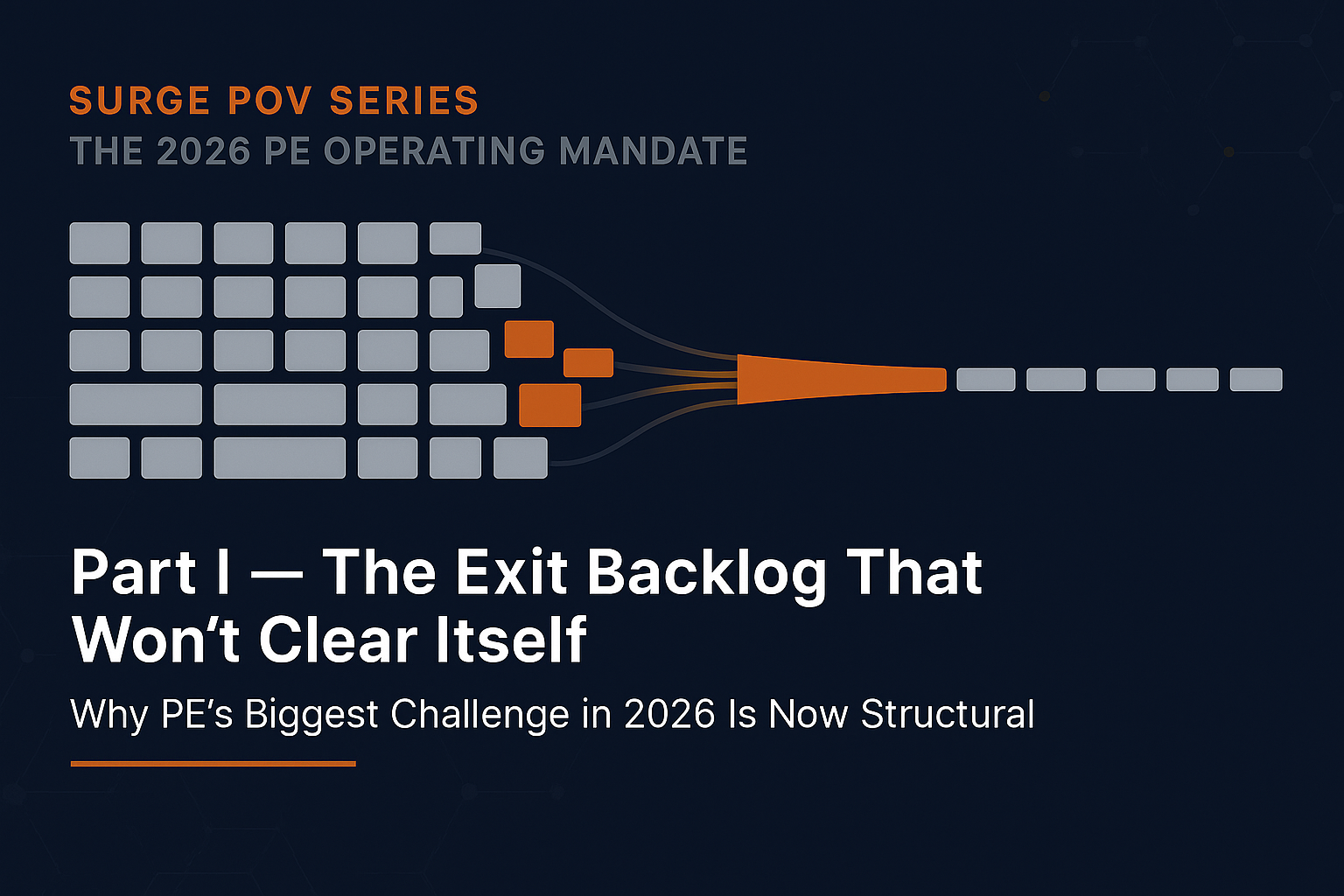
    The Exit Backlog That Won’t Clear Itself: Why PE’s Biggest Challenge in 2026 Is Now Structural

    Surge POV Series, Part 1: The Exit Backlog That Won’t Clear Itself

    Steven Saunders · Surge POV Series · Part I

    Private equity is entering 2026 with a problem that no rate cut, rebound in IPOs, or sponsor-to-sponsor activity can fully solve: the industry is carrying a large, aging inventory of portfolio companies.

    The operating implications extend beyond the exit calendar.

    According to PitchBook’s 2026 US Private Equity Outlook, nearly 12,900 U.S. PE-backed companies sat in sponsor portfolios as of Q3 2025. The age profile of that inventory tells the real story:

    • 30% are 7+ years old
    • 37% are 4-6 years old
    • The median age of still-held assets has risen from 3 years (2022) to 3.9 years (2025)

    That is not a temporary delay caused by a slow 2023 exit market. It is a structural shift.

    Cohorts that should be long gone are still on the books

    The 2017 deal cohort – which should be approaching the end of a normal cycle – still has 37.1% of companies un-exited as it enters year nine. In contrast, the comparable 2012 cohort was down to 26.4% at the same point.

    But even more striking: the 2021 record-year cohort is exiting half as fast as 2017 did.

    At year four:

    • 2021 cohort: 16.6% exited
    • 2017 cohort: 32.3% exited

    If the current pace continues, only half of the 2021 assets will be exited by year ten – a radical departure from historical monetization cycles.

    This is no longer a backlog. It’s a bottleneck.

    The real issue isn’t just market conditions – it’s organizational drift

    Yes, exits slowed because the IPO window froze, debt costs rose, valuation gaps widened, and buyers became selective. But those explanations only describe the environment, not the assets themselves.

    The bigger reality is this: the longer an asset sits, the more misalignment can accumulate inside it.

    Inside many portcos today, you see patterns that weren’t as present in prior cycles:

    • Strategic priorities that shifted three times in five years
    • Leadership turnover that hasn’t been fully absorbed
    • Commercial, product, and operational teams pulling in different directions
    • Value-creation plans that no longer match the current competitive environment
    • Critical decisions made slowly or not at all
    • Teams still executing on a 2021 or 2022 thesis in a 2026 market

    These issues compound. By year six or seven, some companies are no longer simply misaligned – their functions are operating against different versions of the strategy.

    That makes them harder to grow. And therefore harder to exit.

    Organizational drift can deepen a backlog that market conditions alone will not resolve.

    Why this matters: fundraising pressure is rising

    PE firms are already navigating a fundraising landscape where capital is concentrating at record levels. PitchBook reports that the top 10 funds captured 45.7% of 2025 capital raised through the report’s November 6 data cutoff.

    LPs have become far more selective, backing managers who can:

    • Deploy capital with precision
    • Exit assets on time
    • Demonstrate repeatable operational capability

    If exits continue to slip, fundraising becomes even more challenging for mid-market GPs – and the operating burden shifts inward.

    Portcos have to perform. Portcos have to show momentum. Portcos have to become exit-ready not in theory, but in calendar time.

    The new GP mandate: exit acceleration

    Across the industry, sponsors are shifting their operating posture:

    • “Asset by asset” value-creation work is being complemented by portfolio-wide operating disciplines.
    • CEOs are being pushed to reset priorities rather than add new ones.
    • Boards are focusing not just on strategy but on execution rhythm.
    • More sponsors are intervening earlier when organizational drift appears.

    And internal operating partners are asking a sharper question: “What is preventing this organization from going faster?”

    Because in a backlog environment, speed is a differentiator. Speed driven by clarity, alignment, and coordinated execution.

    The central insight: you can’t exit what you can’t align

    Exit markets may improve without resolving the operating challenges inside aging assets.

    GPs cannot rely only on waiting for the market. They need to move their companies.

    Exit readiness requires organizations that are:

    • Clear on the few priorities that matter
    • Aligned across commercial, operational, financial, and product teams
    • Coordinated around the value-creation plan
    • Operating at a pace that creates momentum and confidence
    • Able to deliver consistent signals to buyers

    Those capabilities strengthen the operating story, improve readiness and help companies make use of an open exit window.

    Source: PitchBook, 2026 US Private Equity Outlook, published December 3, 2025. Figures reflect the report’s 2025 data cutoffs; the ten-year scenario is an extrapolation, not an observed outcome.

    Related thinking

    Fundraising Is Consolidating – And It’s Raising the Bar on How PE Firms Operate

    Platform LBOs Are Back – and Execution Risk Is Higher Than Ever
    Back to the Thinking collection →

  • Fundraising Is Consolidating – And It’s Raising the Bar on How PE Firms Operate

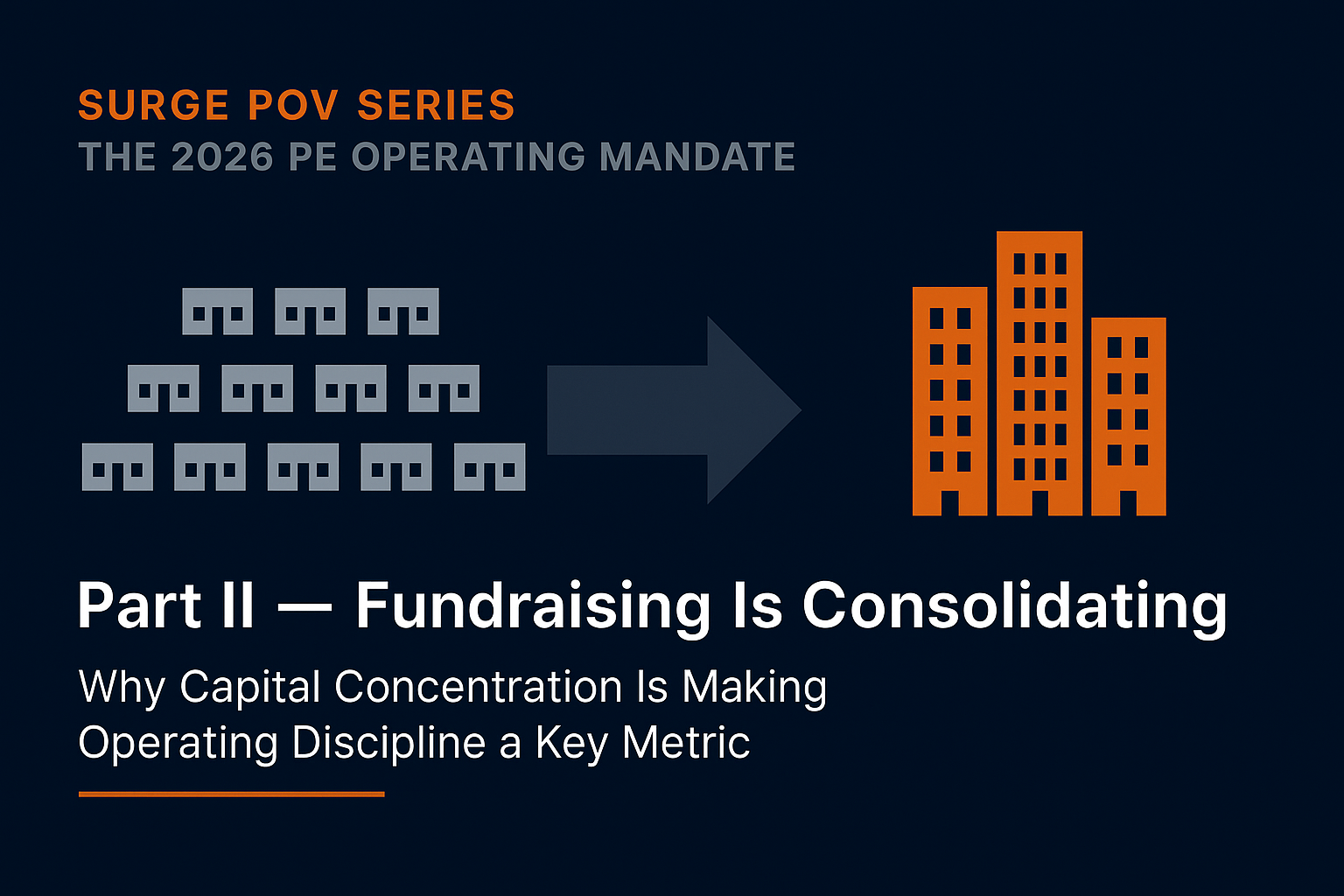
    Fundraising Is Consolidating – And It’s Raising the Bar on How PE Firms Operate

    Surge POV Series, Part 2: Fundraising Is Consolidating

    Steven Saunders · Surge POV Series · Part II

    In the first article of this series, we looked at the growing exit backlog and the organizational drift that can develop inside aging portfolios.

    That pressure also matters for fundraising.

    PitchBook’s 2026 US Private Equity Outlook describes increasing capital concentration. My reading of the operating implication is straightforward: when liquidity is constrained, confidence in execution matters more.

    Capital is concentrating

    Through November 6, 2025, the top 10 PE funds had captured 45.7% of capital raised, compared with 34.5% in 2024.

    The report also shows:

    • 61% of capital raised went to firms with more than 10 funds
    • First-time fund closes fell from 83 in 2024 to 41 in 2025 year to date

    These are figures from the report’s data cutoff, rather than final full-year totals.

    The operating question beneath that concentration is whether a manager can create and realize value consistently.

    This isn’t just a question of scale

    It’s tempting to interpret concentration as a simple preference for megafunds. But scale alone does not resolve the work inside portfolio companies.

    Managers still need to demonstrate:

    • Repeatable execution across cycles
    • Discipline under pressure
    • The ability to drive outcomes inside complex, aging assets
    • A credible path to realizing value during an extended hold

    When exits are delayed and liquidity is constrained, execution risk becomes harder to absorb. Operating capability becomes part of the case a firm must make for its next fund.

    The mid-market squeeze

    For mid-market GPs, the combination of fundraising pressure, longer exit timelines and portfolio complexity narrows the margin for error.

    Strong deal selection and financial structuring remain essential. They cannot consistently compensate for organizational drag.

    The firms that struggle are not necessarily short on ideas. Their portfolio companies may be operating at different speeds. Value-creation plans can look good on paper but decay in execution. Functional leaders may agree on the target while disagreeing on what happens first.

    Those issues do not stay internal indefinitely. They affect performance, buyer confidence and the credibility of the operating story.

    Questions worth answering before LP diligence

    A firm’s execution discipline should withstand questions such as:

    • How quickly do you align the organization post-close?
    • How do you intervene when execution drifts?
    • How do you keep value-creation plans relevant three, five or seven years into a hold?
    • How do you reduce dependency on individual leaders during a transition?
    • How do you detect a loss of momentum before it reaches the numbers?

    These are questions I would use to assess operating capability. They are not a claim that every LP follows the same diligence process.

    The issue is whether a firm has a repeatable way to create clarity, alignment and momentum across very different assets.

    Operating excellence is part of the thesis

    Operating capability is more than a support function that helps the investment thesis. It shapes whether the thesis can become reality.

    Useful disciplines include:

    • Treating alignment as an early intervention that reaches beyond the leadership team
    • Resetting priorities when market assumptions change
    • Connecting boards, management, functional leaders and frontline teams through a clear operating rhythm
    • Reducing time-to-decision
    • Addressing organizational drift before it appears in missed performance or delayed exits

    The objective is coherence: a business moving around the priorities that matter most.

    Execution becomes visible

    A firm’s operating behavior becomes visible through the organizations it owns.

    Can management move decisively? Can priorities become coordinated action across functions? Does a portfolio company sustain momentum through complexity and leadership change?

    Fundraising success has many causes. Execution discipline strengthens the evidence a manager can present about repeatability and realization.

    Why this connects to the exit backlog

    The exit backlog and fundraising pressure can reinforce each other. Delayed realizations constrain liquidity. Tighter fundraising increases scrutiny. Execution weaknesses can then become more consequential.

    Breaking that cycle requires work inside the portfolio companies, rather than reliance on a more accommodating exit market.

    Clarity, alignment and momentum do not guarantee an exit. They improve the organization’s readiness to use an exit opportunity when it appears.

    Source: PitchBook, 2026 US Private Equity Outlook, published December 3, 2025, pages 4-6. Fundraising data is as of November 6, 2025. The operating interpretation is mine.

    Related thinking

    The Exit Backlog That Won’t Clear Itself: Why PE’s Biggest Challenge in 2026 Is Now Structural

    Why the Middle Market Won’t Save Value Creation

    Back to the Thinking collection →

  • Platform LBOs Are Back – and Execution Risk Is Higher Than Ever
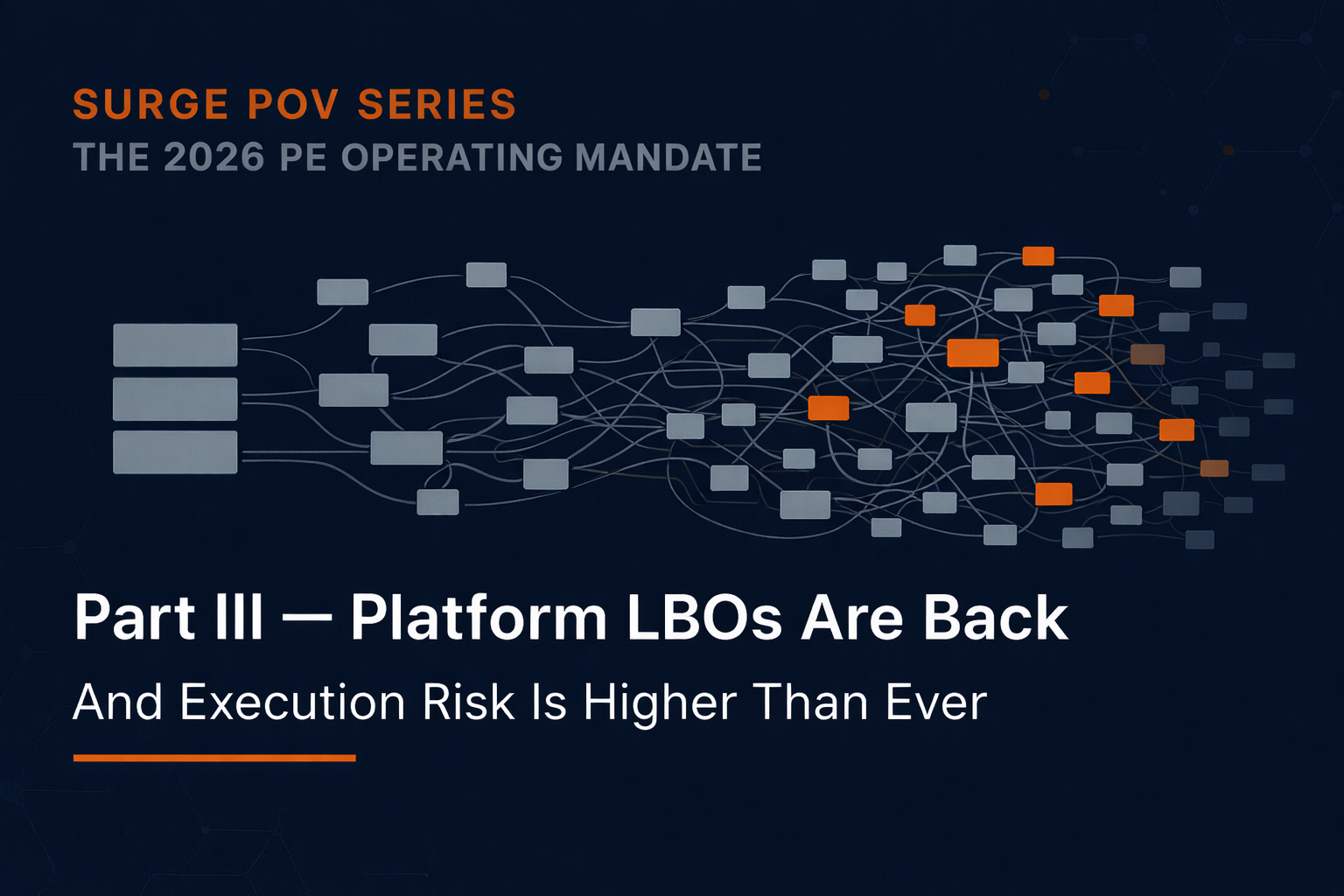
    Platform LBOs Are Back – and Execution Risk Is Higher Than Ever
    Surge POV Series, Part 3: Platform LBOs Are Back

    Steven Saunders · Surge POV Series · Part III

    In the first two articles, we explored how an aging exit backlog and fundraising consolidation change private equity’s operating demands.

    Platform LBOs bring another pressure point: an acquisition creates new expectations while the organization must continue to operate.

    PitchBook’s December 2025 outlook forecast that platform LBOs would reach at least 25% of US PE deal activity in 2026. That was a forward-looking forecast. The execution argument here does not depend on treating it as an observed result.

    Why platform deals feel different

    Platform LBOs have always been execution-intensive. They become less forgiving when they land in organizations already managing:

    • Longer hold periods and accumulated complexity
    • Leadership teams stretched by competing demands
    • Layered value-creation plans
    • Deferred integration across add-ons
    • AI and operating-model change
    • Pressure to produce visible progress quickly

    The challenge is not simply more work. It is the interaction between the work already underway and the new platform agenda.

    Execution risk stacks

    A platform acquisition may introduce new systems, reporting requirements, leaders and growth expectations at the same time.

    If priorities are not resolved across the organization, each function can make sensible local decisions that conflict with the enterprise plan.

    A commercial team may accelerate growth while operations is standardizing delivery. Finance may seek immediate efficiencies while technology is managing integration. None of those objectives is inherently wrong. Their dependencies and sequence need to be worked through.

    The operating margin for error narrows when these choices remain implicit.

    The hidden risk: organizational fragmentation

    Common sources of drag include:

    • Integration plans that never translate into functional priorities
    • Leadership teams aligned on targets but misaligned on sequencing
    • Add-ons integrated financially but not operationally
    • Decision rights that become ambiguous as the business scales
    • More meetings accompanied by slower decisions

    These issues may not register as crises individually. Together, they can erode momentum well before performance metrics flash red.

    Platform deals multiply the consequences of alignment gaps that already exist.

    Why the first 90 days matter

    The first 90 days establish patterns: how decisions get made, which priorities win, whether teams move together, and whether integration feels intentional or improvised.

    Early alignment gives the organization a basis for three things.

    Shared priorities

    A small number of enterprise priorities that leaders and teams can translate into their own work. The test is whether people understand the trade-offs, not whether they have seen the same presentation.

    Decision clarity

    Who decides what, at which level, and how quickly. This becomes especially important when legacy businesses and new owners bring different expectations.

    Operating rhythm

    A cadence that connects board intent, management decisions and frontline action. It should surface dependencies and force decisions rather than simply collect updates.

    When those elements are missing, the organization fills the vacuum with local optimization and competing agendas.

    What disciplined sponsors do differently

    The work begins by bringing together the people who must resolve and execute the agenda.

    They need to:

    • Establish a shared understanding of the few priorities that matter most
    • Resolve sequencing across legacy businesses and add-ons
    • Clarify decision rights before ambiguity becomes entrenched
    • Make dependencies visible across functions
    • Connect commitments to an operating cadence

    Culture and change management matter. They do not substitute for this practical architecture of execution.

    Platform deals reveal operating discipline

    A platform integration provides concrete evidence of how a firm and management team work.

    Does integration create momentum or distraction? Do decisions accelerate or slow? Does the value-creation plan become coordinated action? Is complexity being reduced or merely passed between teams?

    These questions matter to boards, investors and prospective buyers.

    The takeaway

    Platform LBOs are less forgiving when portfolios are complex and timelines are compressed.

    The advantage belongs to firms that can align quickly, decide clearly and coordinate action as the platform grows.

    A strong deal thesis sets direction. The organization has to acquire the capability to deliver it.

    Source: PitchBook, 2026 US Private Equity Outlook, published December 3, 2025, pages 7-8. The platform-deal share is the report’s forecast; the execution analysis is my interpretation.

    Related thinking

    Continuation Funds Have Peaked – Now Comes the Hard Work

    AI Is Reshaping Operating Models – and Widening the Execution Gap

    Back to the Thinking collection →

  • Continuation Funds Have Peaked – Now Comes the Hard Work

    Continuation Funds Have Peaked – Now Comes the Hard Work

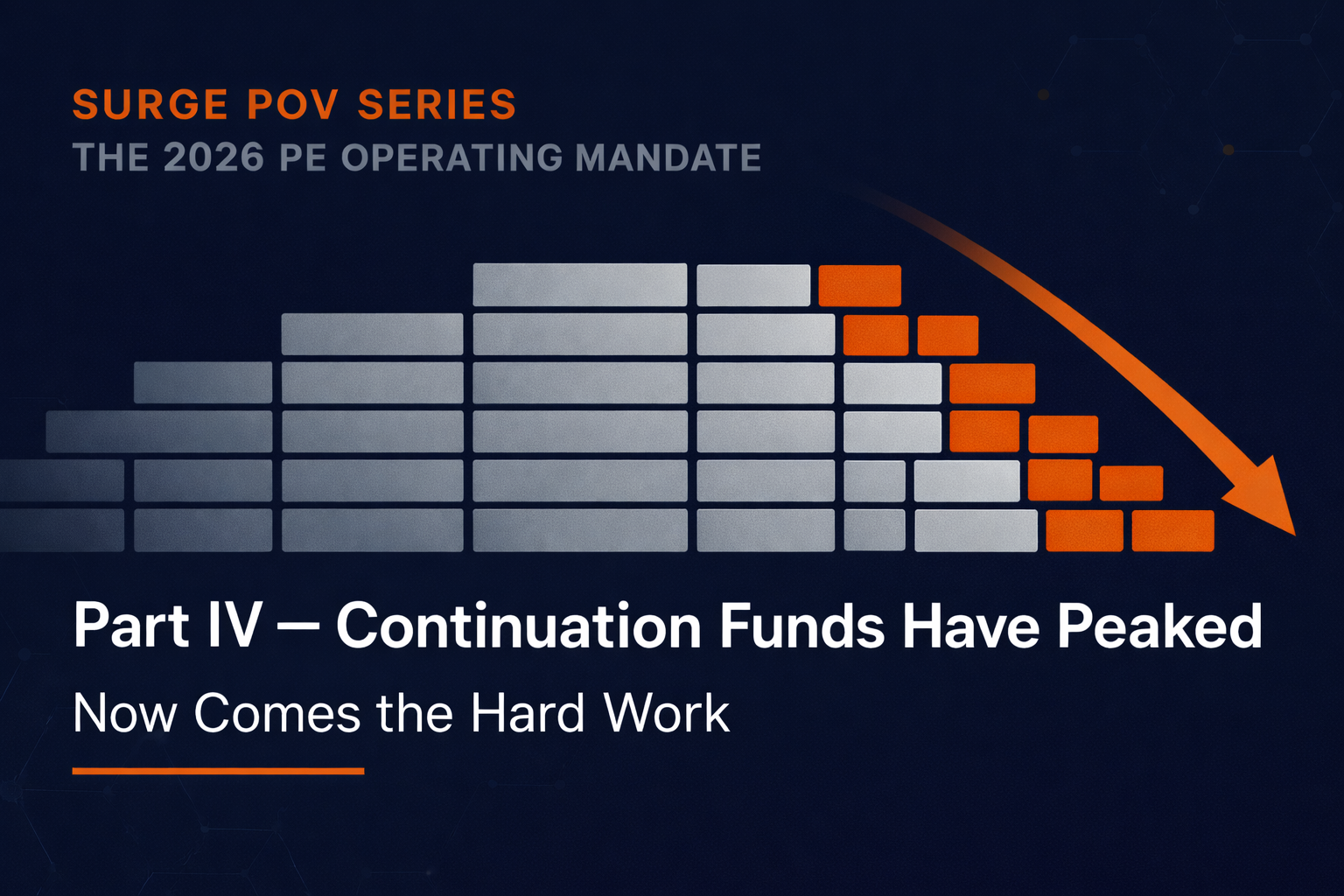
    Surge POV Series, Part 4: Continuation Funds Have Peaked

    Steven Saunders · Surge POV Series · Part IV

    Continuation funds became an important pressure valve when exit markets tightened, valuations diverged and timelines stretched.

    They offered sponsors a way to extend ownership, provide liquidity and preserve optionality without forcing an immediate sale.

    But changing the ownership structure does not automatically change how the organization executes.

    Why continuation funds surged

    Sponsors faced a difficult combination:

    • Assets they still believed could create more value
    • Limited IPO opportunities
    • Cautious strategic buyers
    • Volatile financing conditions
    • LP expectations for liquidity

    Continuation vehicles offered a way to reconcile those tensions. They could provide liquidity, reset ownership and give the company more time.

    In many cases, that flexibility was valuable.

    What the forecast actually says

    PitchBook’s December 2025 outlook forecast that continuation fund-related exits would fall below their 2025 peak in 2026.

    That is a forecast about exit activity, not proof that continuation funds have permanently peaked or lost their usefulness.

    The operating implication is more durable: an extended hold still needs a credible plan for what the organization will do with the additional time.

    A continuation structure can buy time. It does not automatically buy momentum.

    The execution gap inside long-hold assets

    Long-held companies can accumulate:

    • Multiple leadership transitions
    • Layered value-creation plans
    • Operational and organizational debt
    • Legacy priorities alongside new expectations
    • Assumptions that no longer fit the market

    Everyone may be busy. The strategy deck may look current. Initiatives may be underway. Yet progress can feel slower than it should.

    The challenge is often coherence.

    Teams execute against different versions of the plan. Decision rights blur. Priorities compete. What was once a clear value-creation story becomes a collection of activities.

    Extended ownership can preserve that drift unless the operating agenda is deliberately reset.

    The false comfort of more time

    Time creates the opportunity for value. It does not create value on its own.

    The organization still needs:

    • Clear priorities
    • Explicit trade-offs
    • Decisions at the right level
    • Coordinated execution
    • An operating rhythm that sustains momentum

    Without those capabilities, an extension can give unresolved issues more room to compound.

    Treat the vehicle as an execution reset

    The practical question is not only whether the asset deserves more time. It is what must change inside the organization during that time.

    A reset should:

    • Reestablish a small number of enterprise priorities
    • Align leaders and teams around sequencing
    • Clarify decision rights that have eroded
    • Resolve dependencies across functions
    • Rebuild a cadence that connects board intent to frontline execution

    Some of the most valuable work is subtractive: stop initiatives that no longer support the value-creation plan, retire outdated assumptions and make the next set of commitments clear.

    Turning extension into acceleration

    The operating story should be visible in decisions, ownership and progress – not just a revised timeline.

    Has leadership regained momentum? Has the organization reduced complexity? Are the next priorities clear enough for teams to act on? Is the additional time being used deliberately?

    Those questions help distinguish an extension in ownership from a renewal of execution.

    The takeaway

    Continuation funds can be a useful financial structure. The next phase of value creation still depends on what happens inside the asset.

    A deliberate execution reset turns more time into a better chance of operating improvement and exit readiness.

    Source: PitchBook, 2026 US Private Equity Outlook, published December 3, 2025, pages 9-10. The anticipated decline is a forecast; the operating implications are my interpretation.

    Related thinking

    The Exit Backlog That Won’t Clear Itself: Why PE’s Biggest Challenge in 2026 Is Now Structural

    Why the Middle Market Won’t Save Value Creation

    Back to the Thinking collection →

  • AI Is Reshaping Operating Models – and Widening the Execution Gap

    AI Is Reshaping Operating Models – and Widening the Execution Gap

    Surge POV Series, Part 5: AI Is Reshaping Operating Models

    Steven Saunders · Surge POV Series · Part V

    Stalled exits, fundraising concentration, platform complexity and extended holds all place demands on the organization.

    AI introduces another accelerant: technological possibilities can expand faster than the business can adapt its operating model.

    Inside private equity portfolios, that gap between possibility and readiness can become an execution risk.

    Why AI feels different inside PE-backed companies

    Technology initiatives have often been scoped within a function, introduced incrementally and managed through existing workflows.

    AI can affect several parts of the operating model at once:

    • How decisions are made
    • How work is prioritized
    • How teams coordinate
    • How customers are served
    • How responsibilities and controls are assigned

    An initiative may begin inside a function while its consequences reach across the business.

    That is why the organization needs to work through more than the technology choice.

    The execution gap AI exposes

    Organizational readiness is one important source of risk alongside tool quality, data, security, economics and technical implementation.

    Execution problems appear when:

    • Teams pursue use cases independently
    • Pilots proliferate without clear ownership
    • Priorities shift faster than workflows can absorb
    • Leaders struggle to sequence initiatives
    • Decisions slow even while tools promise speed

    AI can amplify existing operating patterns. An aligned organization can make deliberate choices about where to use it. A fragmented organization can add activity without producing coordinated progress.

    Operating models matter alongside tools

    Adding a tool does not resolve who owns the output, how it changes a workflow or which decisions remain with people.

    The operating questions include:

    • What work will change?
    • Who is accountable for the result?
    • Which teams depend on it?
    • What information and controls are required?
    • What must stop or change elsewhere to make room?

    Without those decisions, a technically successful pilot can struggle to become an operating capability.

    What effective adoption looks like

    The organization needs a deliberate approach to scaling what works.

    Useful disciplines include:

    • Aligning leaders on where AI will matter most
    • Clarifying ownership before scaling pilots
    • Redesigning workflows rather than only adding tools
    • Revisiting decision rights as information moves faster
    • Embedding commitments into the operating cadence

    This is organizational work as well as a technology project.

    Why this matters for value creation

    AI may support growth, margins and customer experience. It can also consume management attention, complicate execution or add initiatives without removing others.

    Alignment is one determinant of the outcome. It works alongside investment quality, talent, data, technology and a credible business case.

    The organization’s ability to coordinate matters because the benefits often depend on several functions changing together.

    An operating question for investors

    An AI strategy should be tested against the organization’s capacity to execute it.

    Can the business absorb change without losing momentum? Do leaders realign priorities as capabilities emerge? Does decision speed improve? Is complexity reduced or shifted elsewhere?

    Those questions reveal more than the number of pilots underway.

    The central risk: speed without coherence

    Faster activity does not necessarily produce faster progress.

    In PE-backed environments, where timelines and performance expectations are demanding, AI needs to connect to clear priorities, ownership, decision rights and operating cadence.

    Otherwise, the business risks accelerating work that is not moving in the same direction.

    The takeaway

    AI is not a silver bullet for value creation.

    The firms that benefit will need to make good technology choices and adapt the organization around them.

    The opportunity becomes operating reality when people, workflows and decisions can move together.

    Related thinking

    Platform LBOs Are Back – and Execution Risk Is Higher Than Ever
    Why the Middle Market Won’t Save Value Creation

    Back to the Thinking collection →

  • Why the Middle Market Won’t Save Value Creation

    Why the Middle Market Won’t Save Value Creation

    Surge POV Series, Part 6: Why the Middle Market Won’t Save Value Creation

    Steven Saunders · Surge POV Series · Part VI

    Across private equity, the middle market is often treated as a refuge.

    When exits slow, capital concentrates and competition intensifies at the top end, the narrative returns: deals are smaller, complexity is lower and execution should be more manageable.

    That assumption deserves scrutiny.

    Execution challenges are not confined to large-cap platforms. They also appear inside middle-market companies, where fewer people may carry more responsibilities and coordination depends heavily on individual leaders.

    A recap of the operating reality

    This series has examined:

    • An aging exit backlog
    • Fundraising concentration
    • The execution demands of platform LBOs
    • Continuation vehicles and extended holds
    • AI adoption and operating-model change

    The common thread is the gap between an investment opportunity and the organization’s ability to deliver it.

    Deal size does not remove that gap.

    The middle-market execution assumption

    The middle market can offer closer proximity between leadership and execution, less formal structure and clearer growth opportunities.

    Those conditions can make coordination feel intuitive. Leaders know one another. Decisions happen through relationships. Ownership may seem obvious.

    But informal alignment becomes less dependable as the business adds functions, locations, acquisitions or new technologies.

    The organization can outgrow its operating habits before anyone recognizes the change.

    Complexity didn’t disappear. It compressed.

    Complexity does not scale neatly with company size.

    In a smaller organization, fewer people wear more hats. Functional interfaces may remain unclear. Growth initiatives compete with daily operations. Decisions depend on the availability of a few leaders.

    That is implicit complexity.

    It becomes difficult to manage when:

    • Ownership is assumed rather than assigned
    • Trade-offs are deferred rather than decided
    • Dependencies remain inside individual leaders’ heads
    • Operating cadence collects updates without resolving issues
    • Execution risk hides behind effort and good intentions

    A company can drift for a long time without appearing broken, until performance stalls or an important opportunity is missed.

    Why smaller does not automatically mean safer

    A lower entry price or more room for improvement may make a deal attractive. Neither ensures that the organization can execute the plan.

    A middle-market company that misses integration timelines, struggles to translate strategy into action or relies on heroic management effort still carries material execution risk.

    The challenge can be harder to address when roles, decision rights and coordination were never made explicit.

    The real divider: execution discipline

    Size, sector and sourcing strategy all matter. So does the ability to:

    • Translate strategy into a small number of executable priorities
    • Resolve those priorities across functions and teams
    • Establish a rhythm that surfaces dependencies and produces decisions
    • Make ownership explicit across organizational layers
    • Detect drift and correct it early

    These capabilities help a business sustain momentum as its complexity increases.

    Moving beyond the middle-market myth

    The middle market offers real opportunities. It does not offer an exemption from organizational work.

    People still need to align, decide, coordinate and adapt. The value-creation plan still needs to become operating reality.

    Private equity’s operating advantage comes from building organizations that can move together through complexity, rather than assuming a smaller deal will be easier to execute.

    For those looking to go deeper

    Cracking Complexity explores how organizations work through complex challenges. It offers further context for the alignment, decision speed and coordination themes in this series.

    Related thinking

    Fundraising Is Consolidating – And It’s Raising the Bar on How PE Firms Operate

    AI Is Reshaping Operating Models – and Widening the Execution Gap

    Back to the Thinking collection →